
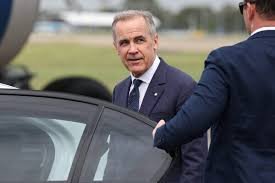
Prime Minister Mark Carney Addresses Strikes on Iran
Prime Minister Mark Carney, speaking from Sydney, Australia, has voiced his support for recent U.S. and Israeli air strikes on Iran, albeit “with regret.” He argues that while Tehran poses the greatest threat to stability in the Middle East, the military actions represent a breakdown of the rules-based international order and potentially violate international law.
Mr. Carney’s comments, made during a press conference on Wednesday, are seen as an attempt to distance himself from the decisions made by U.S. President Donald Trump and Israeli Prime Minister Benjamin Netanyahu. He emphasized that this support stems from a concern over the continued decline of the international order, leading to a rapidly escalating conflict and increasing threats to civilian lives as Iran retaliates against Israel and countries hosting U.S. military bases.
A Failure of International Law?
The Prime Minister stated that the pre-emptive attacks “prima facie, appear to be inconsistent with international law,” highlighting a broader dysfunction within the global system of treaties and laws. He firmly ruled out any direct Canadian military involvement in the conflict, asserting that it is the responsibility of the United States and Israel to justify their actions under international law.
“That formal judgment is for others to make,” Mr. Carney clarified, while acknowledging that Canada was not consulted prior to the attacks. This echoes sentiments expressed in his January speech to the World Economic Forum, where he warned of the erosion of the rules-based international order.
Iran’s Threat and Canada’s Position
Despite expressing regret, Mr. Carney underscored the significant threat he believes Iran poses to global security. He detailed decades of alleged violations of international law by the Islamic Republic, labeling it “the biggest exporter of terror in the world” and citing its repression of its own citizens and pursuit of nuclear weapons.
Canada’s stance on Iran has been hardening for years. Diplomatic ties were severed in 2012 under former Prime Minister Stephen Harper, a decision that has remained unchanged under Justin Trudeau. Canada has also been a vocal critic of Iran’s actions, including the downing of a commercial plane carrying Canadian citizens and residents in 2020, and designated Iran’s Islamic Revolutionary Guards Corps as a terrorist entity in 2024. CBC News provides further details on this designation.
Mr. Carney emphasized that Canada’s support for the strikes is not unconditional, urging the U.S. and Israel to prioritize the protection of civilians and civilian infrastructure. The primary motivation behind Canada’s position is to prevent Iran from acquiring nuclear weapons.
Defense Minister Weighs In
Defence Minister David McGuinty affirmed that Canadian military personnel in the Middle East are safe and not involved in the operations. He described the deceased former leader of Iran, Ayatollah Ali Khamenei, as “a force for evil.” However, he also stressed Canada’s distance from the military actions themselves.
Internal debate within the Liberal Party regarding Canada’s stance has emerged, with some, like former cabinet minister Lloyd Axworthy, criticizing the lack of UN authorization for the strikes, drawing parallels to Canada’s refusal to support the 2003 U.S. invasion of Iraq. Liberal MP Will Greaves also voiced opposition, condemning the unilateral use of force and the targeting of civilians.
Despite these internal disagreements, Defence Minister McGuinty highlighted the Liberal Party’s commitment to open dialogue and debate, emphasizing the importance of finding a path forward.



