
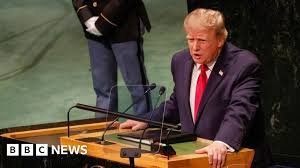
President Donald Trump and the Iran Crisis: Coercive Diplomacy at the UN
The atmosphere at the United Nations in New York has reached a boiling point. In a striking display of coercive diplomacy, President Donald Trump has balanced the prospect of high-level negotiations with the chilling threat of “annihilating” the Islamic Republic if a resolution to the ongoing conflict is not reached.
Amidst a backdrop of geopolitical instability, US and Iranian officials recently convened for critical talks. While no immediate breakthrough was announced, the meetings—mediated by Qatar—mark the first significant diplomatic contact since the collapse of the June ceasefire.
Peace Through Strength: The Trump Strategy
During his address to the UN General Assembly, President Donald Trump didn’t mince words. Eschewing traditional deal-making, Trump championed a philosophy of “peace through strength,” arguing that ultimatums are more effective than compromise. He framed the conflict as a necessary measure to prevent Tehran from acquiring nuclear capabilities.
The US President posed a stark choice to the world: either a deal is struck that limits Iran’s growth, or the US will take extreme action to ensure they can never “kill and destroy people and countries again.” This aggressive posture is a hallmark of his foreign policy, keeping the door to negotiation open while simultaneously threatening overwhelming force.
The Economic Tinderbox: The Strait of Hormuz
The conflict is not merely political; it is an economic crisis. The closure of the Strait of Hormuz has sent shockwaves through global markets. Consider the stakes:
- n
- Energy Flow: Approximately 20% of the world’s oil and liquefied natural gas (LNG) typically passes through this narrow waterway.
- Market Volatility: The blockade has caused wild fluctuations in energy prices, impacting economies worldwide.
- Military Escalation: Both sides have engaged in intermittent skirmishes, with the US attacking Iranian tankers and Iran targeting vessels crossing the strait without authorization.
For more on how energy shifts affect global stability, the International Energy Agency (IEA) provides comprehensive data on oil market trends.
Domestic Pressure and the November Elections
Critics and analysts suggest that Trump’s rhetoric is not only aimed at Tehran but also at domestic voters. With the Congressional elections in November approaching, the President used his UN platform to tout accomplishments in immigration, border security, and the economy.
There is significant pressure on the administration to stabilize the Middle East before the midterms. Trump has hinted that a definitive deal with Iran may finally emerge shortly after the election, suggesting that the current tension is a calculated prelude to a final agreement.
A Fragile Hope for Diplomacy
Despite the fiery rhetoric, there are signs of cautious optimism. Steve Witkoff, the US envoy, reported that a round of discussions had been completed and expressed hope that they would prove “constructive and promising.” On the other side, Iran’s Foreign Minister Abbas Araghchi continues to demand an end to US “acts of aggression” as a prerequisite for lasting peace.
As the world watches, the tension remains palpable. Between the threat of total war and the hope of a diplomatic breakthrough, the strategy of President Donald Trump continues to reshape the landscape of global power.



