
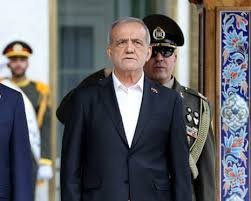
Internal Turmoil in Tehran: Is President Pezeshkian on the Brink?
The political landscape in Iran is currently a powder keg of tension. Recent reports have surfaced suggesting a deep strategic divide between the administration of President Masoud Pezeshkian and the hardline factions that hold significant sway over the nation’s destiny. At the center of this storm are accusations of resignation, secret diplomatic maneuvers, and the enigmatic presence of the new supreme leader, Mojtaba Khamenei.
The Resignation Scandal: Fact or Fiction?
In a recent television interview marking his second anniversary in office, President Pezeshkian was forced to address explosive claims that he had repeatedly threatened to resign—both verbally and in writing. These allegations were brought to light by Mohammad Bagher Kharazi, a figure closely linked by marriage to Mojtaba Khamenei.
Pezeshkian vehemently denied these claims, stating: “If I want to resign, I will officially announce that I have resigned. I will not resign, I will stand.” The President accused his detractors of attempting to create a rift within the Iranian government to destabilize his leadership.
The Enigma of Mojtaba Khamenei
Adding to the instability is the mysterious status of the new supreme leader, Mojtaba Khamenei. Reports indicate that Khamenei was severely injured during an Israeli bombing on the first day of the war—an attack that also claimed his father’s life. Since then, he has remained out of the public eye, leading to speculation about his health and current whereabouts.
This absence has created a power vacuum and increased friction. Kharazi claimed that Pezeshkian’s frustration stems from being excluded from critical decision-making processes, a situation exacerbated by the supreme leader’s seclusion for fear of foreign intelligence agencies.
The High-Stakes Gamble: The Strait of Hormuz
The core of the conflict lies in Iran’s approach to the United States. The US and European powers are pushing for a deal to ensure the stability of the Strait of Hormuz, a vital artery for global oil shipping. While Pezeshkian views a memorandum of understanding as a cornerstone for future foreign relations, the hardliners are not convinced.
The Assembly of Experts, dominated by conservatives, recently issued a scathing statement, describing the hope for an agreement with the US as “futile.” They labeled the diplomatic efforts as an “unforgivable betrayal,” claiming that trusting the US government is nothing more than a mirage.
Key Points of the Internal Conflict:
- Diplomatic Divide: Pezeshkian advocates for strategic engagement with the US, while the Assembly of Experts demands total resistance.
- Power Dynamics: The influence of Mojtaba Khamenei’s inner circle continues to challenge the executive branch.
- Economic Pressure: The urgency to secure the Strait of Hormuz clashes with ideological purity.
- Political Stability: Accusations of “sinister coalitions” and “reckless extremism” are being traded between reformists and hardliners.
Conclusion: A Nation at a Crossroads
As Iran navigates this turbulent period, the clash between the pragmatic approach of Masoud Pezeshkian and the uncompromising stance of the hardline factions surrounding Mojtaba Khamenei will determine the country’s trajectory. Whether a deal can be reached to stabilize the Middle East or if internal strife will lead to further instability remains to be seen.
For more real-time updates on Middle East geopolitics, stay tuned to authoritative sources like Reuters Middle East News.



