
Poland to Deploy Landmines Along Eastern Border Amidst Russia Threat
Warsaw will now utilize landmines to defend its eastern frontier against the escalating threat posed by Russia, announced a Polish Deputy Defence Minister to the Associated Press on Friday. This move coincides with the country’s official withdrawal from an international convention prohibiting the use of these contentious weapons.
The 1997 Convention on the Prohibition of Anti-Personnel Landmines, also known as the Ottawa Treaty, forbids signatory states from possessing or employing these mines, which can remain active for years and are notorious for causing severe harm to civilians in former conflict zones, including Cambodia, Angola, and Bosnia and Herzegovina.
Poland, which ratified the treaty in 2012 and completed the destruction of its national stockpile of anti-personnel mines in 2016, officially withdrew on Friday and announced its intention to resume production of these weapons.
Strategic Defence on NATO’s Eastern Flank
“These mines are one of the most important elements of the defence system we are building on the eastern flank of NATO, in Poland, on the border with Russia to the north and with Belarus to the east,” stated Paweł Zalewski, Polish Deputy Defence Minister. He emphasized that Poland must defend itself against Russia, a nation he described as harbouring “very aggressive intentions towards its neighbours” and which has never adhered to the Ottawa Treaty.
Since Russia’s full-scale invasion of Ukraine, neighbouring countries have been reassessing their participation in the international treaty. Last year, Warsaw joined Finland, the three Baltic states (Estonia, Latvia, and Lithuania), and Ukraine in announcing their withdrawal from the treaty. Russia is among the approximately 36 countries, including the United States, that have never signed the Ottawa Treaty.
Boosting Domestic Production
Mr. Zalewski indicated that Poland would launch domestic production of anti-personnel and anti-tank mines, and the government would cooperate with Polish manufacturers, aiming for self-sufficiency.
Landmines are explosive devices placed on or just below the surface of the ground, detonating when a person or vehicle steps on them. Anti-tank mines, designed not to be triggered by a person’s weight, are not prohibited by the Ottawa Convention.
Rapid Deployment Capability
Speaking on Thursday after observing a demonstration of the Bluszcz, an unmanned vehicle designed for the dispersal of anti-tank mines produced by Polish company Belma S.A. and a military research institute, Polish Prime Minister Donald Tusk stated that Poland would “soon” be able to mine its eastern borders within 48 hours in the event of a threat. Given the extent of the country’s eastern borders, Mr. Zalewski clarified that “many” landmines would be required.
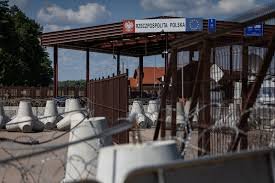
Poland asserts that it will only use mines in the event of a “real threat of Russian aggression.” The country plans to stockpile mines as part of the Eastern Shield, a system of reinforced fortifications it has been constructing along its borders with Belarus and Russia since 2024, according to Mr. Zalewski. However, he clarified that Poland would only deploy these mines along its borders “in the event of a real threat of Russian aggression.”
“We deeply respect our territory and do not want to exclude its daily use for Polish citizens,” explained Mr. Zalewski.
International Criticism
Human rights organizations have condemned the decisions to withdraw from the Ottawa Treaty, arguing that anti-personnel mines are too dangerous for civilians. However, Mr. Zalewski responded that the country is striking a balance by keeping these mines in reserve for use only in the event of an attack. “We are not an aggressive country,” he maintained. “But we must use all means to deter Russia.”
Learn more about international security and defence strategies at NATO’s official website.



