
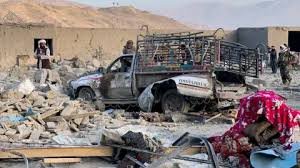
Pakistan-Afghanistan Border Clash: Escalating Tensions and Casualties
Tensions between Pakistan and Afghanistan have dramatically escalated following a series of clashes along their shared border. Pakistan reports that two of its soldiers were killed and three injured after the Afghan Taliban launched an operation targeting military positions late Thursday. The incident marks a significant deterioration in already fragile relations between the two nations.
What Sparked the Conflict?
The Afghan Taliban claims the operation was a response to Pakistani strikes earlier this week, alleging these strikes resulted in at least 18 civilian deaths. Islamabad, however, maintains that it targeted alleged militant camps and hideouts within Afghanistan, citing recent suicide bombings within Pakistan as justification. This reciprocal accusation of aggression highlights the core of the conflict: differing narratives regarding security concerns and cross-border terrorism.
Taliban military spokesman Mawlawi Wahidullah Mohammadi stated the “retaliatory operation” began around 8:00 PM local time (3:30 PM GMT) on Thursday. Zabihullah Mujahid, the Taliban’s chief spokesman, asserted that the offensive resulted in the deaths of “numerous” Pakistani soldiers and the capture of others – claims vehemently denied by Pakistani officials.
Conflicting Reports and Official Responses
A spokesman for Pakistan’s Prime Minister, Mosharraf Zaidi, dismissed Mujahid’s claims of captured military posts and damage on the Pakistani side, promising an “immediate and effective” response to any further aggression. Mujahid, via X (formerly Twitter), accused Pakistani military circles of repeated border violations and supporting insurgency, justifying the “large-scale preemptive operations” against Pakistani army centers and installations.
Pakistan’s government countered, stating the Taliban “miscalculated and opened unprovoked fire” across the border in Khyber Pakhtunkhwa province. A Ministry of Information & Broadcasting statement shared on X claimed “heavy casualties on [the] Afghan side with multiple posts and equipment destroyed.” The statement affirmed Pakistan’s commitment to protecting its territorial integrity and the safety of its citizens.
Impact on Civilians and Border Operations
Residents near the border reported intense exchanges of fire. Those living near the Torkham border town were urged to evacuate, and the repatriation of deported Afghan nationals was temporarily suspended due to the clashes. The crossing was also closed to Afghan refugees, exacerbating an already challenging humanitarian situation. This disruption underscores the immediate human cost of the escalating conflict.
A History of Tensions
This latest exchange of fire follows a fragile ceasefire agreed upon in October after previous deadly cross-border clashes. However, sporadic fighting has continued to plague the region. The 1,600-mile (2,574 km) mountainous border between Pakistan and Afghanistan has long been a source of contention, with both sides accusing the other of harboring militants and failing to adequately control the border region. Understanding this historical context is crucial to grasping the complexity of the current situation. For more information on the region’s geopolitical landscape, see Council on Foreign Relations – Afghanistan.
Looking Ahead
The current escalation raises serious concerns about regional stability. The potential for further escalation and the humanitarian consequences for civilians are significant. Diplomatic efforts to de-escalate the situation and address the underlying security concerns are urgently needed. The future of Pakistan-Afghanistan relations hangs in the balance.



