
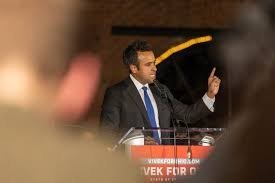
Money, Power, and Politics: The High-Stakes Race for Ohio’s Governor’s Mansion
The Ohio governor race has transformed into a financial battlefield, where the influence of a single billionaire may be outweighing the collective contributions of thousands of donors. As the political climate heats up, the contest between Republican Vivek Ramaswamy and Democrat Amy Acton is providing a masterclass in modern campaign strategy and the sheer power of Super PACs.
The Billionaire Influence: The Yass Factor
Recent reports have sent shockwaves through the Ohio political landscape. Jeffrey Yass, a Pennsylvania billionaire and prominent supporter of school choice programs, has significantly tipped the scales. Yass has reportedly funneled at least $30 million into V-PAC: Victors not Victims, a Super PAC dedicated to propelling Vivek Ramaswamy to victory.
To put this number into perspective, Yass’s individual contribution alone exceeds the total reported fundraising of Amy Acton, who has raised approximately $21.8 million for her entire campaign. This financial disparity allows the Ramaswamy camp to dominate the airwaves with a massive spending advantage.
An Ad War of Epic Proportions
The financial gap translates directly into visibility. According to data from Medium Buying, a Republican political ad tracking firm, the disparity in spending is staggering:
- n
- Team Ramaswamy: $82.3 million spent or reserved for TV and digital ads.
- Team Acton: Approximately $11.1 million in expected pro-Acton spending.
While the Democratic Governors Association is planning a significant push after Labor Day, Ramaswamy’s allies have been running a relentless campaign to frame Acton as “too liberal” and “erratic,” a strategy that appears to be gaining traction in recent polling data.
Amy Acton’s Strategic Pivot to the Center
Facing a barrage of attacks and a tightening race, Amy Acton is making a calculated move toward the political center. In an effort to appeal to moderate and independent voters, Acton has taken several stances that diverge from traditional Democratic party lines, including:
- n
- Voter ID: Expressing support for the voter ID amendment.
- Medicaid: Backing Medicaid work requirements.
- Sports: Supporting the ban on transgender girls and women in women’s sports.
- Law Enforcement: Opposing the elimination of qualified immunity for police officers.
These moves have already yielded results, as Acton recently secured an endorsement from the Ohio Patrolmen’s Benevolent Association, the state’s second-largest police union. This pivot highlights the delicate balancing act Acton must perform to win over a diverse Ohio electorate while maintaining her base.
What This Means for Ohio Voters
The Ohio governor race is no longer just about policy platforms; it is a clash of ideologies and financial muscle. With the 2026 elections approaching, the influence of Super PACs—which can raise and spend unlimited sums—continues to redefine how campaigns are won and lost.
As voters weigh the experience of a public health official against the energy of a political outsider, the question remains: will the massive spending of the Ramaswamy camp secure the win, or will Acton’s centrist evolution resonate more deeply with the people of the Buckeye State?
To stay informed about campaign finance laws and how they impact elections, you can visit the Federal Election Commission (FEC) website.



