
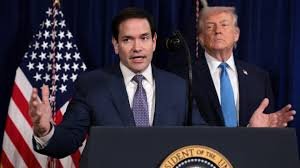
Marco Rubio: A Masterful Navigator in the Trump Era
Staying within President Donald Trump’s inner circle often comes at a cost – either facing the president’s disapproval or compromising one’s own moral compass to maintain alignment. However, few have navigated the turbulent waters of the Trump administration as effectively as Secretary of State Marco Rubio. He has remarkably managed to remain in the president’s good graces while simultaneously mitigating the damage Trump’s actions can inflict on international relationships.
The Art of Policy Laundering
Rubio has demonstrated a unique ability to present legitimate conservative foreign policy arguments within the context of the Trump presidency. This isn’t merely about survival; it’s a strategic approach to shaping policy. He’s successfully steered the president towards embracing serious conservative doctrines, pursuing legitimate foreign policy goals, and lessening the impact of Trump’s often-abrasive rhetoric towards allies.
The Monroe Doctrine Reimagined
A prime example is the Trump administration’s renewed focus on the Monroe Doctrine – the principle of American dominance in the Western Hemisphere. Given Rubio’s long-standing and unparalleled focus on Latin America during his time in the Senate, it’s highly likely that his influence played a significant role in this shift. The recent actions regarding Venezuela, including the attempt to capture Nicolás Maduro, reflect this doctrine, even if the legality of such actions, bypassing Congressional approval, remains a point of contention. However, the pursuit of regime change in Venezuela aligns with conservative foreign policy objectives. For further insight into the Monroe Doctrine, see The Council on Foreign Relations’ overview of the Monroe Doctrine.
Assuaging European Concerns
Rubio’s diplomatic skills extend to Europe, where he’s worked to reassure allies concerned about the reliability of the United States under Trump. At the Munich Security Conference, he addressed European concerns about trade, U.S. defense spending, and immigration, framing these issues not as demands but as opportunities for mutual benefit.
“We do not want our allies to be weak, because that makes us weaker,” Rubio stated in Munich on February 14th. “We want allies who can defend themselves so that no adversary will ever be tempted to test our collective strength.” This approach, unlike Trump’s often-confrontational style, fostered a cooperative atmosphere and strengthened NATO’s unity. Trump himself even joked that Rubio was so effective he deserved to be fired!
A Contrast in Styles: Rubio vs. Others
Many within the Trump administration have faltered by becoming mere “yes-men,” blindly supporting the president’s policies regardless of their merit. Individuals like Homeland Security Secretary Kristi Noem and Attorney General Pam Bondi have suffered from this approach. Others, like former Secretary of State Rex Tillerson, attempted a more direct approach to disagreement, which ultimately led to their dismissal.
Rubio’s success lies in his ability to present ideas as Trump’s own, ensuring the president feels ownership of the policies being pursued. He skillfully steers Trump towards sound policy while simultaneously mitigating damage when the president deviates from established norms. This requires a delicate balance of diplomacy and political acumen.
The Future Remains Uncertain
The Secretary of State position is inherently challenging for someone with Trump’s temperament, and the administration is still relatively early in its term. A future rift between Trump and Rubio is certainly possible. However, for now, Rubio stands as a beacon of competence within a frequently dysfunctional administration. His ability to navigate the complexities of the Trump era is a testament to his political skill and a valuable asset to American foreign policy.
Dace Potas is an opinion columnist for USA TODAY and a graduate of DePaul University with a degree in political science.



