
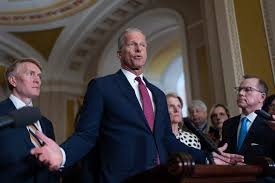
John Thune Leads Republicans in Contentious Homeland Security Funding Battle
WASHINGTON – Republicans in Congress are pursuing a high-stakes strategy to fully fund the Department of Homeland Security (DHS), which has faced a prolonged shutdown nearing two months. The impasse stems from Democratic demands for changes to President Trump’s immigration enforcement policies. Senate Majority Leader John Thune announced on Tuesday that Republicans will attempt to pass funding for Immigration and Customs Enforcement (ICE) and Customs and Border Protection (CBP) “the hard way,” effectively bypassing Democratic opposition.
Democrats are advocating for a funding bill that includes restraints on federal immigration authorities, such as improved officer identification and increased reliance on judicial warrants. According to John Thune, these demands will be ignored as bipartisan negotiations have stalled. Republicans are now preparing a partisan bill utilizing a complex and time-consuming process called budget reconciliation, which requires only a simple majority vote in the Senate.
A Risky Path Forward
The process is anticipated to be challenging. John Thune is championing a focused bill solely dedicated to funding ICE and CBP, aiming for a swift reopening of the department. However, some Republican colleagues may seek to incorporate unrelated priorities into the legislation.
Democrats remain steadfast in their call for agency reforms. Senate Democratic Leader Chuck Schumer stated, “Americans want ICE and Border Patrol reined in.”
Narrow Bill Focus & Presidential Support
John Thune and GOP leaders aim to expedite the legislation through Congress, focusing solely on Homeland Security funding to facilitate a rapid department reopening. A meeting between Wyoming Senator John Barrasso, Senate Budget Committee Chairman Lindsey Graham, and President Trump at the White House on Friday resulted in a deadline of June 1st for a focused reconciliation bill funding ICE and CBP, as announced by Barrasso.
President Trump expressed his support on social media, stating, “we are moving FAST and FOCUSED in keeping our Border SECURE!”
Potential Complications and Broader Legislative Goals
Despite the focus on a narrow bill, challenges remain. Senators and the House may attempt to add other items to the legislation, such as President Trump’s proof-of-citizenship bill (the SAVE Act) or funding requests related to international conflicts. Farm-state senators are also pushing for a comprehensive farm bill to bolster the agricultural economy, while some Republicans propose program cuts to offset the legislation’s estimated $75 billion cost.
Republican leaders suggest a second partisan budget reconciliation bill to address these additional issues. However, skepticism exists within the party regarding the feasibility of achieving this, given the narrow GOP margins in both chambers and the approaching election.
Senator John Hoeven of North Dakota acknowledged the “narrow vision” while admitting that other ideas are being considered.
Prolonged Shutdown and Previous Attempts at Resolution
The Homeland Security Department has been shut down since mid-February. The situation arose after federal agents shot two protesters in Minneapolis, prompting a Democratic request to separate the DHS bill from a larger spending measure. However, the DHS funding lapsed due to disagreements over immigration enforcement tactics.
In March, the Senate passed legislation to separate ICE and CBP funding from the rest of the department, but House Republicans rejected it, demanding inclusion of immigration enforcement funding. Following a two-week recess, John Thune and House Speaker Mike Johnson announced a two-track approach: passing the Senate bill for most of the department’s funding through regular order and utilizing the party-line bill for ICE and CBP funding. However, Johnson’s ability to secure support from his members remains uncertain.
John Thune has proposed funding the agencies for three years through the budget bill, aiming to prevent future shutdowns during President Trump’s term. This would provide funding “not only today but well into the future.”
Source: AP News



