
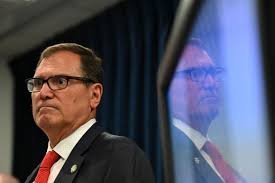
The Legal Battle Over Executive Power: The John Sarcone Ruling
In a decision that sends ripples through the American legal system, a divided federal appeals court has delivered a significant John Sarcone US attorney appointment ruling. The Second Circuit Court of Appeals determined that the appointment of John Sarcone as the Acting US Attorney for the Northern District of New York was unlawful, effectively stripping him of his authority in high-profile investigations.
This 2-1 decision upholds a previous January ruling, concluding that Sarcone’s appointment did not follow legal protocols. Consequently, he is now disqualified from continuing the investigation into one of the administration’s most prominent legal adversaries, New York Attorney General Letitia James.
Why the Appointment Was Ruled Unlawful
At the heart of this controversy is the Federal Vacancies Reform Act. The court’s majority, led by Judge Maria Araujo Kahn and Judge Guido Calabresi, argued that the executive branch attempted to bypass the constitutional Senate confirmation process.
The court found that according to the Act, only the First Assistant already in place at the time of a vacancy can automatically step into the role. In Sarcone’s case, the administration appointed a First Assistant after the vacancy occurred, which the judges described as a “deliberate and discretionary choice” designed to evade congressional oversight.
“The Government’s reading thus rewards evasion and penalizes compliance,” the majority wrote, emphasizing that the law exists specifically to prevent the Executive branch from skirting legislative checks and balances.
A Pattern of Legal Challenges
The ruling regarding John Sarcone is not an isolated incident. It marks the third time a federal appeals court has rejected the Trump administration’s method of naming US attorneys without Senate approval. Several other cases highlight a systemic legal struggle:
- n
- Nevada: The Ninth Circuit Court of Appeals ruled that US Attorney Sigal Chattah is serving unlawfully.
- New Jersey: The Third Circuit determined that Alina Habba was not validly appointed.
- Virginia: The Fourth Circuit is set to hear arguments regarding the appointment of former lawyer Lindsey Halligan.
What Happens to the Active Investigations?
The impact of these rulings depends on the specific involvement of the attorneys. In instances where the unlawfully appointed US attorney acted alone, indictments and subpoenas—including those involving former FBI Director James Comey—were dismissed. However, in cases where legally serving assistant US attorneys were also involved, the charges often remained intact.
While Sarcone can no longer serve as the Acting US Attorney, he continues to operate as the First Assistant US Attorney. He recently held a press conference regarding a criminal complaint involving an ISIS-inspired plot, demonstrating that his role in general law enforcement continues, even as his authority in specific political probes is curtailed.
The Road to the Supreme Court
The Department of Justice (DOJ) has not conceded. In a statement via social media, the DOJ expressed its disagreement with the ruling and announced its intention to take the case to the Supreme Court.
Judge Michael Park, who dissented from the majority, argued that the executive branch must be able to function during periods of political stalemate. He suggested that any first assistant to a vacant office should be eligible to serve as an acting officer, provided they stay within the 210-day limit set by section 3346 of the Vacancies Act.
As this legal saga unfolds, it underscores the ongoing tension between executive efficiency and the legislative requirement for transparency and confirmation in the US judicial system.



