
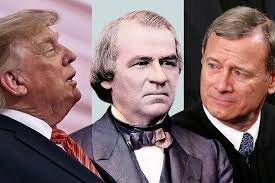
The Paradox of the Modern Supreme Court
In recent political cycles, the United States has witnessed a striking contradiction. On one hand, the Supreme Court is often hailed as the final barricade against autocracy—as seen when it prevents the disruption of mail-in voting. On the other hand, a more troubling trend has emerged: a series of rulings that seem to insulate the presidency from the very laws designed to prevent corruption and election interference.
At the center of this judicial evolution is Chief Justice John Roberts and a court that is increasingly redefining the boundaries of executive power. But is the court truly defending democracy, or is it paving the way for an “imperial presidency”?
Enforcing Statutes vs. Defying the Law
To understand the current state of the judiciary, we must distinguish between two very different roles the Court plays:
- Enforcing Federal Statutes: This is a constitutional duty. When the court blocks illegal tariffs or protects birthright citizenship, it is simply applying the laws written by Congress. This is the foundation of the rule of law.
- Judicial Supremacy: This is the more dangerous power. Since the 1850s, the Court has claimed the authority to dissolve any statute if a majority of justices dislike its constitutional judgment. This allows the court to effectively “veto” laws that were meant to restrain the president.
The Historical Echo: From Andrew Johnson to John Roberts
This tension isn’t new. Following the Civil War, Congress passed the Reconstruction Acts to secure black suffrage and protect a multiracial democracy. When President Andrew Johnson attempted to sabotage these efforts, Congress fought back with legislation like the Tenure of Office Act.
At the time, the idea that a president could simply ignore a federal law because he disagreed with its constitutionality was viewed as a “more than kingly prerogative.” However, over the next century, the narrative shifted. The doctrine of judicial supremacy took hold, arguing that the Court—not Congress—should be the ultimate authority on what the president can and cannot do.
Fast forward to today, and John Roberts has invoked the legacy of past justices like William Howard Taft to protect the executive branch from congressional oversight. In cases such as Trump v. Slaughter, the court has dismantled statutory protections for public servants, replacing independent agency leaders with political loyalists.
The Danger of Presidential Immunity
The most alarming shift occurred in Trump v. United States, where the court essentially exempted the president from significant portions of federal criminal law. This creates a legal vacuum where corruption and obstruction no longer bind the most powerful officer in the land.
When the judiciary decides that the president is above the law, it doesn’t just protect one individual; it weakens the entire democratic structure. If Congress cannot pass “sticky laws”—laws that actually hold the executive accountable—the balance of power is permanently broken.
The Path Forward: Restoring Accountability
To save the democratic framework, the focus must shift from judicial supremacy back to legal accountability. A court that is required to enforce federal statutes would still protect the Constitution, but it would lose the power to immunize the president from the laws written to restrain him.
The choice facing the United States is clear: do we want a court that places the president above the law, or a court that holds him to it? For more information on the structure of the federal judiciary, you can visit the official Supreme Court of the United States website or explore the Constitution Annotated for deeper legal context.
The survival of a healthy democracy depends on our ability to ensure that no one—regardless of their title—is beyond the reach of the law.



