
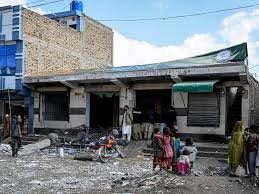
IED Attacks in Balochistan: Risks to US and China Investments
Balochistan, Pakistan, is strategically positioned at the heart of ambitious economic partnerships between Pakistan, the United States, and China. However, recent coordinated attacks serve as a stark reminder of the inherent risks facing both Pakistan and potential investors in the region. The province’s rich mineral deposits are attracting international attention, but escalating violence threatens to derail these opportunities.
A Glimpse of Promise and a Shadow of Doubt
In September, Pakistan’s army chief presented a collection of valuable minerals to US President Donald Trump, signaling Pakistan’s willingness to open its mineral resources to American investment. This offer, however, is now overshadowed by a surge in unrest. Most of Pakistan’s most valuable mineral deposits are located in Balochistan, a province grappling with longstanding separatist movements fueled by grievances over perceived neglect by the federal government.
On Saturday, coordinated attacks across Balochistan resulted in the deaths of 31 civilians and 17 security personnel, while the military reportedly killed 145 fighters. This urgent reminder highlights the challenges Pakistan – and prospective investors – face in the province. The attacks are particularly sensitive given Balochistan’s central role in China’s investments in Pakistan.
Accusations and Counter-Accusations
Following the attacks, Pakistan’s Interior Minister Mohsin Naqvi immediately blamed neighboring India, alleging Indian involvement in planning and supporting the attacks. “These were not normal terrorists. India is behind these attacks. I can tell you for sure that India planned these attacks along with these terrorists,” Naqvi stated, though without providing supporting evidence. India swiftly rejected these allegations, dismissing them as an attempt to deflect attention from Pakistan’s “internal failings.”
The Baloch Liberation Army (BLA) and the “Herof 2.0” Operation
The attacks were claimed by the Baloch Liberation Army (BLA), a separatist group advocating for independence for Balochistan and engaged in a decades-long insurgency against the Pakistani state. BLA leader Bashir Zeb announced the attacks as part of their “Herof 2.0” operation, a continuation of a similar coordinated assault launched in August 2024.
Deep-Rooted Issues Beyond Blame Games
Analysts emphasize that the crisis in Balochistan extends far beyond any single incident. Ignoring the underlying issues will hinder Pakistan’s efforts to attract investment from both the US and China. Balochistan, home to approximately 15 million of Pakistan’s 240 million people, is the country’s poorest province despite its vast natural resource wealth, including significant reserves of oil, coal, gold, copper, and gas.
Pakistan has pledged portions of this resource wealth to China, its closest ally, and to the US under a landmark agreement signed last year. Concerns are mounting that escalating violence could jeopardize projects worth billions of dollars and threaten Pakistan’s fragile economic recovery.
A History of Separatism and Government Response
Annexed by Pakistan in 1948, Balochistan has been a site of separatist movements almost since the country’s inception. The province has experienced at least five major rebellions. The current phase began in the early 2000s, evolving from demands for greater control over local resources to calls for full independence. The government’s response has been characterized by heavy-handed security operations, leading to accusations from human rights groups of killings and enforced disappearances of ethnic Balochs suspected of separatist ties.
In March, BLA fighters attempted to hijack a passenger train, the Jaffer Express, resulting in a day-long operation and the deaths of at least 33 fighters. This incident was part of a broader increase in violence across Balochistan. According to the Pakistan Institute for Peace Studies, the province saw at least 254 attacks in 2025, a 26 percent increase from the previous year, resulting in over 400 deaths.
China’s Investments and the CPEC
The recent violence coincides with Pakistan’s efforts to attract Chinese investment, particularly through the $60 billion China-Pakistan Economic Corridor (CPEC). China has already heavily invested in Balochistan, including the development of Gwadar, Pakistan’s only deep-sea port, a key node in the CPEC. In September, USSM, a US-based mining firm, signed a $500 million memorandum of understanding to invest in mineral excavation in Pakistan.
A Core Contradiction
Saher Baloch, a researcher focusing on Balochistan, points to a “core contradiction” in Pakistan’s approach: emphasizing the province’s resources to attract international partners without addressing the underlying political grievances. “Balochistan’s instability isn’t episodic. It is structural and rooted in longstanding grievances over ownership, political exclusion and militarisation,” she explains. She argues that large-scale extraction projects will remain high-risk and heavily securitized, primarily viable for state-backed actors like China.
Investor Awareness and Strategic Calculus
Abdul Basit, a research fellow, offers a different perspective, suggesting that China and the US are fully aware of the risks. “They both know the risk profiles and what they are getting into,” he states, noting that both countries continued investment despite previous attacks. He believes these are government-to-government deals based on strategic investment calculations.
Pakistan’s Economic Challenges
Pakistan’s economy has faced significant pressure in recent years, narrowly avoiding default in 2023 with a bailout from the International Monetary Fund (IMF). While the country has regained some stability under its latest IMF program, foreign direct investment (FDI) remains weak. Figures released last month showed a sharp decline in FDI from July to December, with the country receiving just $808 million during the first half of the fiscal year 2026, down from $1.425 billion the previous year.
A Volatile Situation
Imtiaz Gul, executive director of the Islamabad-based Centre for Research and Security Studies, believes the surge in violence is deterring investors. “No sane national or international investor will risk their money in an extremely volatile situation,” he says. Balochistan’s porous border with Iran’s Sistan-Baluchestan province further contributes to the region’s perception as a “high-risk zone.”
The situation demands a comprehensive approach that addresses both the security concerns and the underlying political and economic grievances of the Baloch people. Without such an approach, the promise of Balochistan’s resources may remain unrealized, and the region will continue to be a source of instability.
Follow Al Jazeera English for further updates.



