
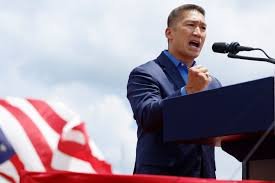
From the Shadows to the Helm: Hung Cao’s Rise to Acting Navy Secretary
In a whirlwind of political maneuvering and strategic realignment, the leadership of the United States Navy has undergone a seismic shift. As detailed in reports by Jacqui Heinrich, Hung Cao—a retired Navy captain and former Republican Senate candidate—has officially stepped into the role of Acting Navy Secretary.
This transition follows the abrupt removal of Navy Secretary John Phelan by President Donald Trump and Defense Secretary Pete Hegseth. For Cao, this promotion is more than just a title change; it is an escape from a professional vacuum.
The “Boxed In” Era: Cao’s Struggle Under Phelan
Despite serving as the Undersecretary of the Navy, Cao’s influence was surprisingly limited during his tenure under John Phelan. Sources close to the situation suggest that Cao was effectively “put in a box,” sidelined from critical decision-making processes and excluded from official meetings that a typical No. 2 civilian would lead.
His portfolio, which was supposed to encompass personnel issues and the safeguarding of the Navy’s “warfighter ethos,” became a formality rather than a function. However, the tide turned instantly with Phelan’s ouster. Cao learned of his promotion via a brief, direct call from the Pentagon front office: “Ok, you’re it — we made a change.”
Who is Hung Cao? A Warrior’s Journey
Hung Cao is not a typical political appointee. His life story is one of resilience and military excellence:
- n
- Refugee Roots: Immigrating to the US as a child after his family fled Vietnam during the war.
- Decorated Career: A graduate of the US Naval Academy (1996), he served as a Navy diver and explosive ordnance disposal officer.
- Combat Experience: Extensive deployments across Iraq, Afghanistan, and Somalia.
- Political Ambition: A staunch Trump ally who ran for the US Senate in Virginia, championing an “America First” vision.
A New Direction: Shipbuilding and Military Culture
Taking the lead at a critical juncture—particularly with heightened tensions in the Strait of Hormuz—Cao has made his priorities clear. His primary focus is the acceleration of US Navy shipbuilding priorities, the very issue that reportedly led to Phelan’s dismissal.
Beyond infrastructure, Cao is set to steer the Navy’s internal culture. Known for his outspoken opposition to Diversity, Equity, and Inclusion (DEI) initiatives, Cao believes the military must return to a focus on “alpha” leadership to solve recruiting crises. He famously asserted that the Navy needs warriors who are prepared to “rip out their own guts” to win wars.
The Trump-Hegseth Connection
The appointment reflects the tight-knit synergy between Cao, Defense Secretary Pete Hegseth, and President Trump. Unlike his predecessor, Cao has signaled absolute loyalty to the current administration’s chain of command, promising to provide feedback internally while fully supporting the President’s ultimate decisions.
One of Cao’s first significant acts as Undersecretary was addressing the fallout of the COVID-19 vaccine mandate, issuing a heartfelt apology to sailors who were discharged for their conscience—a move that aligns perfectly with the administration’s current personnel philosophy.
What Lies Ahead for the Navy?
While it remains unclear if Cao will be formally nominated for the permanent position, his current leadership marks a pivot toward a more aggressive, traditionalist approach to maritime superiority. As the Department of Defense navigates complex global threats, all eyes are on whether Cao’s “battle-tested” leadership can deliver the results the administration demands.
This analysis is based on insights and reporting by Jacqui Heinrich, highlighting the intersection of military strategy and political loyalty in the modern Pentagon.



