
Donald Trump Intervenes as TSA Faces Shutdown Chaos
As a growing number of Transportation Security Administration (TSA) agents work tirelessly amidst the ongoing government shutdown, President Donald Trump announced on Saturday a plan to deploy Immigration and Customs Enforcement (ICE) officers to airports by Monday. This move comes as a response to increasingly lengthy security lines and the financial strain on unpaid TSA employees.
The ICE Deployment: Questions and Concerns
The Trump administration has yet to detail the specific roles ICE agents will assume at airports. A key concern is their lack of specialized training in security screening, a skill that requires months of dedicated preparation for TSA screeners. George Borek, a TSA officer and union steward in Atlanta, expressed skepticism, stating, “The president can have (ICE agents) come there but I don’t see how that helps us in getting through this time period,” emphasizing the critical need for proper training. CNN has reached out to the White House and the Department of Homeland Security for further clarification.
The Impact of the Shutdown on TSA
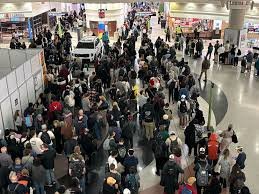
The partial government shutdown is severely impacting TSA operations. With 61,000 employees working without paychecks, hundreds have already resigned, leading to significant staffing shortages. This has resulted in frustratingly long security checkpoint lines at major airports across the country, and officials warn the situation could worsen if the political deadlock continues. The financial strain and low morale are pushing TSA agents to their limits.
Mounting Delays and Potential Airport Closures
By Sunday, delays were already escalating. Hartsfield-Jackson Atlanta International Airport reported wait times exceeding two and a half hours, while LaGuardia, Houston’s George Bush Intercontinental, and John F. Kennedy International airports faced waits of over 40 minutes. The Department of Transportation Secretary Sean Duffy warned that the upcoming week of travel will be even more challenging, describing current woes as “child’s play” in comparison.
What Can ICE Agents Do?
While the effectiveness of ICE deployment remains uncertain, agents could potentially assist with non-security tasks such as managing lines, directing passengers, and facilitating the checkpoint process, freeing up trained TSA officers for critical security functions. However, Borek cautions that untrained personnel could pose risks, stating, “If you bring people in there, they are not trained, they don’t know what they’re looking for, then certainly it could be a problem.”
A Growing Crisis
TSA callout rates have consistently exceeded 9% for six consecutive days, reaching a record 10.22% on Monday, as employees continue working without pay. More than a third of screeners at Hartsfield-Jackson Atlanta International Airport were absent last week, causing delays of up to two hours. At Houston’s William P. Hobby International Airport, over half of TSA workers called out on Friday.
TSA acting Deputy Administrator Adam Stahl warned that if the shortage of workers worsens, some airports might be forced to close entirely. “It’s not hyperbole to suggest that we may have to quite literally shut down airports, particularly smaller ones, if callout rates go up.”
The Screening Partnership Program: A Potential Solution?
Interestingly, 20 US airports, including San Francisco International and Kansas City International, utilize the TSA’s Screening Partnership Program, employing private companies for security screening. These airports are currently experiencing fewer disruptions and shorter lines.
A Recurring Problem
This partial government shutdown is not an isolated incident. TSA staff have faced missed paychecks due to three funding lapses in the past six months, including a historic 43-day shutdown last year and a brief lapse in January. The ongoing financial hardship is taking a toll on TSA agents, leading to evictions, food insecurity, and overdrawn bank accounts.
As the stalemate in Congress continues, over 400 TSA officers have already quit, and many more are taking unscheduled time off due to financial constraints. Union leaders report that some workers are leaving their jobs to seek alternative employment, while others are unable to afford the costs associated with commuting to work.
Source: CNN



