
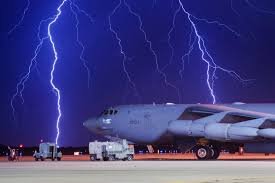
CENTCOM Operations: The Enduring Legacy of the B-52 Stratofortress in Iran
The Boeing B-52 Stratofortress, first taking to the skies in 1952, continues to be a pivotal asset in U.S. military operations. From Vietnam to Desert Storm, the Global War on Terror, and now, the ongoing operations in Iran, this legendary aircraft demonstrates remarkable longevity and adaptability. U.S. Central Command (CENTCOM) reported Tuesday that U.S. forces have engaged over 2,000 targets within Iran since the commencement of Operation Epic Fury on February 28th, incorporating both B-1 Lancer bombers and the venerable B-52 Stratofortress into the air campaign.
B-52 in Operation Epic Fury
Recent reports indicate that B-1B Lancer bombers conducted long-range strikes deep within Iranian territory as of Sunday night. General Dan Caine, Chairman of the Joint Chiefs of Staff, stated during a Pentagon briefing on Monday that these strikes, targeting ballistic missile facilities and command-and-control infrastructure, have “established local air superiority.” This enhanced air superiority is crucial for protecting U.S. forces and enabling continued operations within Iran.
On Tuesday, CENTCOM confirmed via X (formerly Twitter) the deployment of a fleet of B-52s, affectionately nicknamed “Stratosaurus” due to its age, in a strike against ballistic missile and command control posts. This highlights the continued relevance of this aircraft in modern warfare.
Technical Specifications and Capabilities
The B-52H is a formidable aircraft, capable of high subsonic speeds at altitudes reaching 50,000 feet. It boasts the capacity to carry both nuclear and precision-guided conventional ordnance, with a payload of approximately 70,000 pounds of mixed ordnance – including bombs, mines, and missiles – as detailed by the U.S. Air Force. Learn more about the B-52’s capabilities on the Air Force website.
A History of Service
The prototype YB-52 Stratofortress first flew on April 15, 1952, marking America’s first all-jet engine intercontinental strategic bomber. Historian Carl O. Schuster notes that Boeing’s ingenious design – a remarkably light, simple, and durable airframe with substantial internal space – has facilitated continuous upgrades throughout the 21st century. The B-52’s ability to adapt and remain relevant is a testament to its original design.
Vietnam and Beyond
The B-52D was the most prevalent version during the Vietnam War, becoming the cornerstone of America’s strategic bomber force in 1965. Operation Linebacker II, in December 1972, saw B-52s unleashed for eleven days against Hanoi and Haiphong, ultimately compelling North Vietnam to return to the negotiating table, as documented by historian Stephen Wilkinson.
Since then, the B-52 has remained in continuous service, demonstrating its enduring value to the U.S. military. During a recent Pentagon press briefing regarding Operation Epic Fury, General Caine, alongside Defense Secretary Pete Hegseth, revealed that the U.S. has struck over 2,000 targets across Iran and destroyed more than 20 of the Islamic Republic’s naval vessels.
Source: Military Times



