
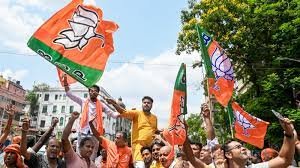
The Verdict of History: A New Chapter for West Bengal
In the realm of politics, there are standard election results, and then there are verdicts of history. What the people of West Bengal have recently delivered in the assembly elections falls squarely into the latter category. The current trends leave no room for doubt: Bengal has not simply swapped one government for another; it has fundamentally altered its political destiny.
This is far more than an ordinary victory for the BJP in West Bengal. It is a landslide mandate and a historic signal of rejection toward a political order long defined by fear, patronage, and institutional intimidation. The resounding defeat of the Trinamool Congress (TMC)—a party once deemed electorally invincible—demonstrates the sheer power of a democratic will determined to reclaim its future.
Breaking the Cycle of Coercion
For decades, West Bengal remained trapped in a political culture where vision was often overshadowed by violence. The legacy of the Left institutionalized a system of cadre-based coercion, which eventually mutated into a politics of selective inclusion and systemic erosion of democratic confidence. From the tragic Marichjhapi massacre to the daily intimidation of voters, the state’s political landscape had become a battlefield of fear.
The rise of the BJP in West Bengal represents an ideological homecoming. By honoring the legacy of Syama Prasad Mookerjee, the founder of the Bharatiya Jana Sangh, this victory serves as an overdue tribute to national unity and constitutional integrity.
The Engine of Success: Karyakartas and Strategic Precision
What made this monumental shift possible? The answer lies in the discipline and relentless commitment of the BJP karyakartas. No other political organization in India matches their scale and dedication. These workers reached every village, every ward, and every booth, persisting through adversity and intimidation to ensure democratic participation.
Much of this organizational success is attributed to Amit Shah, whose political clarity and booth-level precision transformed aspiration into a tangible electoral execution. His ability to energize the cadre was the catalyst for this historic transition.
The Modi Effect: Governance and National Integration
This victory strengthens the broader governance framework led by Prime Minister Narendra Modi. By integrating West Bengal into the BJP-NDA continuum, the state can now benefit from coordinated governance between the state and the Centre. We have already seen the transformative power of this approach in Assam and the wider Northeast, where stability and infrastructure have flourished.
The momentum of the BJP in West Bengal is part of a larger national trend:
- n
- Democratic Resistance: In states like Tamil Nadu, the politics of cultural hostility is facing unprecedented pushback.
- Organizational Growth: In Kerala, the BJP is finding resonance through a focus on development and national integration.
- Inclusive Growth: PM Modi’s appeal transcends caste and region, focusing on direct delivery and aspirational citizenship.
A Democratic Correction
For the women, youth, and marginalized communities of Bengal, this mandate is a cry for equality. They no longer wish to be viewed as fragmented “vote banks” but as equal stakeholders in India’s growth story. After decades of broken promises and stalled aspirations, the people have spoken with absolute clarity: Enough.
This is not just a day for celebration; it is a day of vindication. As the saying goes, “Andhera Chatega, Suraj Niklega, Kamal Khilega” (The darkness will fade, the sun will rise, and the lotus will bloom). West Bengal has finally stepped out of the shadows and into a new era of peace, development, and dignity.



