Mexico Cartel Violence: A Nation on Edge After ‘El Mencho’s’ Death
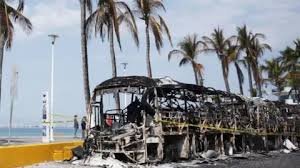
Driving through Guadalajara, Mexico, the scars of Sunday’s terrifying cartel rampage are still painfully visible. Charred vehicles line the roadsides, and scorched asphalt marks the highways – a stark reminder of the Jalisco New Generation Cartel (CJNG)’s response to the reported death of their leader, Nemesio “El Mencho” Oseguera. The CJNG, one of Mexico’s most powerful and feared cartels, unleashed chaos by setting scores of vehicles ablaze, projecting a clear message: their power remains intact, with or without their chief, capable of unleashing havoc and sowing fear on a massive scale.
Government Response and Public Unease
Mexico’s President Claudia Sheinbaum is attempting to counter this narrative, speaking of a return to “peace and tranquility” and praising the security forces’ response. However, the increased presence of troops and police in Guadalajara, while intended to reassure, has instead amplified the sense of unease among residents. The streets are noticeably emptier than usual, a testament to the widespread fear of further violence, not just in Guadalajara but throughout the state of Jalisco.
Many small businesses remain shuttered, and schools are closed, as people stay home with their families. Anwar Montoya, the owner of the Severo café, is an exception. “I had to open today. We’re a new business, and I have a lot of things to pay for,” he explains, acknowledging the fear but emphasizing the need to continue operating. He hopes his café can provide a “secure area” for the community, and his customers seem to appreciate the gesture.
A Cycle of Violence and a Question of Strategy
Left-wing parliamentary deputy Mariana Casillas sees the recent events as part of a larger, deeply rooted problem. “This is not a new scenario,” she states, referring to Mexico’s ongoing drug war. “Only on this occasion, because it involved the killing of a top capo, the violence exploded in a much more potent fashion than normal.” She points out that organized crime, roadblocks, burning buses, and kidnappings have plagued her community for two decades, since the state’s conflict with the cartels began during Felipe Calderón’s presidency in 2006.
“As a local representative, it’s my duty to ask why this model has continued to be repeated for more than twenty years,” Casillas adds. She argues that Mexico views life as disposable in the eyes of the drug cartels, and the government’s focus on eliminating high-profile leaders fails to address the underlying issues of violence and poverty that fuel gang recruitment.
The ‘Kingpin Strategy’ and its Consequences
With over 60 funerals being organized for both CJNG members and National Guard troops, Casillas’s concerns resonate deeply. Drug war expert Deborah Bonello, managing editor of Insight Crime, echoes this sentiment. “The execution of the kingpin strategy in Mexico over the last two decades – the extraction or the killing of major leaders like El Mencho – has always resulted in the same thing: more violence,” she explains. “When you take out a major leader, there’s a detonation of a struggle to take control in that vacuum. So, you’ll see these squabbles for power in different parts of the country.”
World Cup Concerns and a Community’s Plea
Guadalajara is scheduled to host the FIFA World Cup in June, including a match between Spain and Uruguay. However, the recent violence has raised serious questions about the safety of the event. Anwar Montoya expresses disbelief when asked about the competition. “I’ve never been to a World Cup, so I don’t know how they work in other countries. But I don’t think this is a safe place for the World Cup.”
Mariana Casillas agrees, highlighting the “very painful crises” unfolding in Jalisco, including the “crisis of violence” and the “crisis of the disappeared.” Tens of thousands of people have been reported missing in Mexico since 2007, many forcibly recruited by cartels or murdered for resisting.
The Mexican government insists Guadalajara is prepared to host the World Cup, with President Sheinbaum claiming there is “no risk” and “all the guarantees” are in place. FIFA boss Gianni Infantino has also expressed reassurance. However, Casillas is adamant: “The people here don’t want the World Cup. They want security, they want clean water, and they want their disappeared relatives back.”
The recent surge in violence, sparked by the reported death of El Mencho, underscores the complex and deeply entrenched challenges facing Mexico. It raises critical questions about the effectiveness of current strategies and the urgent need for a more comprehensive approach that addresses the root causes of cartel violence and prioritizes the safety and well-being of its citizens.
Insight Crime provides in-depth analysis of organized crime in Latin America and the Caribbean.
BBC News offers ongoing coverage of the situation in Mexico.