
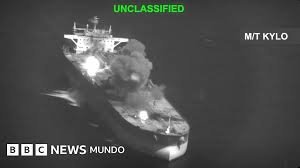
Escalation in the Gulf: US and Iran Trade Blows in Naval Conflict
The volatile waters of the Middle East have once again become a flashpoint for global tension. In a series of rapid-fire retaliatory strikes, the United States and Iran have exchanged attacks on naval vessels, marking a dangerous escalation after a brief period of relative calm. The conflict, which has now stretched over six months, threatens not only regional stability but also the global economy.
Strategic Strikes: Centcom vs. the IRGC
The U.S. Central Command (Centcom) recently announced a decisive operation to dismantle clandestine financial networks. According to official reports, US forces “permanently disabled” two tankers near Kharg Island and the Strait of Hormuz, while a third vessel in the Gulf of Oman was completely destroyed.
The US asserts that these vessels were part of a multi-billion dollar shadow network used to fund the Islamic Revolutionary Guard Corps (IRGC) and its regional proxies. However, the retaliation was swift. Iranian state media confirmed that Tehran launched counter-attacks against three US-linked vessels and three tankers navigating “unauthorized” routes through the Strait of Hormuz.
The Strait of Hormuz: A Global Economic Chokepoint
At the heart of this confrontation lies the Strait of Hormuz, one of the most critical maritime passages in the world. To understand the gravity of this conflict, one must look at the numbers:
- n
- Oil Volume: Approximately 20% of the world’s total oil and liquefied natural gas (LNG) supply passes through this narrow strait.
- Iranian Control: Tehran views the strait as a primary lever of influence, frequently challenging ships that avoid Iranian-preferred routes.
- Economic Ripple Effect: Any disruption in this zone leads to immediate volatility in global energy markets.
Political Friction and the “Minor Matter” Paradox
While the military situation intensifies, the political rhetoric from Washington remains contradictory. President Donald Trump has characterized the conflict as a “minor matter,” suggesting that the intermittent clashes are not a full-scale war. However, the domestic reality tells a different story. With mid-term elections approaching, the impact on American consumers is becoming impossible to ignore.
The price of diesel in the United States has surged, reaching an average of $5.85 per gallon, a stark increase from the $3.71 average recorded a year ago. This inflation, driven by geopolitical instability, puts significant pressure on the administration to find a resolution.
Human Costs and the Diplomatic Deadlock
Beyond the strategic maneuvering, the human cost is rising. Reports from the Iranian Red Crescent suggest that missile shrapnel hit a wedding ceremony in Sirik, resulting in casualties, including children. While US Vice President JD Vance expressed skepticism regarding these claims, the incident has been labeled a “war crime” by Tehran.
With the 60-day ceasefire having expired last month and no diplomatic breakthrough in sight, the US has signaled a shift toward harsher economic sanctions against Iran and any nation facilitating its trade. As the world monitors the International Energy Agency (IEA) reports for signs of further oil shocks, the question remains: will diplomacy prevail, or is the region heading toward a larger confrontation?



