
Unveiling Sierra Leone’s Dark Secret: An Investigation into the Shadowy Ritual Killings
Sierra Leone, a nation often grappling with the echoes of civil war and epidemics, faces a more insidious and deeply unsettling threat: ritual killings. These horrific acts, often linked to supposed black magic or ‘juju’ rituals, leave families traumatized and communities gripped by fear. A groundbreaking investigation by BBC Africa Eye delves into this clandestine trade in human body parts, exposing the networks behind it and the tragic struggle for justice.
A Mother’s Agony: The Unsolved Murder of Papayo
The pain of unsolved crimes casts a long shadow over Sierra Leone. Four years ago, Sallay Kalokoh’s 11-year-old son, Papayo, vanished after going to sell fish at the market in Makeni. Two weeks later, his mutilated corpse was found in a well, vital organs, eyes, and an arm brutally removed. “Today I’m in pain. They killed my child and now there is just silence,” Sallay recounted to BBC Africa Eye. Her anguish is compounded by the fact that no one has been brought to justice, and authorities didn’t even officially classify it as a “ritual killing.”
This tragic case highlights a pervasive issue in the country, where parents constantly warn their children about the dangers of strangers and isolated areas. Reports of killings linked to black magic, or juju, frequently surface but are rarely pursued or properly investigated, leaving communities vulnerable and desperate for answers.
The Lure of Power: Inside the Juju Network
The belief in juju and its purported power to grant wealth and influence is deeply entrenched in some parts of West Africa. Illicit practitioners exploit this belief, promising clients prosperity and power in exchange for large sums, claiming that human body parts amplify the potency of their charms.
During their investigation, the BBC Africa Eye team uncovered individuals claiming to be juju practitioners, openly offering to procure body parts for ritual purposes. These individuals boasted of extensive networks and powerful clients spanning across the region.
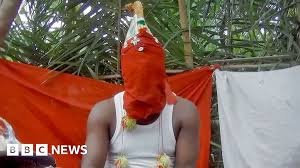
One undercover operative, posing as a politician seeking power, met a juju man named Kanu in a secret shrine in a remote area near the Guinean border. Kanu, wearing a red ceremonial mask, bragged about his connections to “big, big politicians” in Guinea, Senegal, and Nigeria, hinting at the heightened risk of abductions during election seasons.
On a subsequent visit, Kanu chillingly displayed a human skull, claiming it belonged to a woman and was awaiting collection. He also pointed to a pit behind his shrine: “This is where we hang human parts. We slaughter here, and the blood goes down there…” When pressed for specifics, Kanu quoted a price of 70 million leones (£2,500; $3,000) for a woman’s limbs, revealing the horrifying commodification of human life.
Battling Superstition and Scarcity: Challenges to Justice in Sierra Leone
The pursuit of justice in these cases is fraught with challenges. Sierra Leone, with a population of 8.9 million, has only one pathologist, making it incredibly difficult to gather forensic evidence. Compounding this, the pervasive belief in witchcraft and juju, even among some police officers, often leads to fear and reluctance to investigate cases thoroughly, resulting in a staggering number of unsolved murders.
Many juju men masquerade as herbalists, who are legitimate traditional healers using local plants for medicine. According to the World Health Organization (WHO), Sierra Leone had around 1,000 registered doctors in 2022, compared to an estimated 45,000 traditional healers. Most Sierra Leoneans rely on these healers, who also address mental health issues and incorporate mysticism into their practices.
Sheku Tarawallie, president of Sierra Leone’s Council of Traditional Healers, vehemently condemns “diabolic” juju men, stating they tarnish the image of legitimate healers. “We are healers, we are not killers,” he asserted, highlighting efforts to establish a traditional medicine clinic to legitimize and regulate their practice. Tarawallie believes that the lust for power and money drives these ritualistic acts, where human parts are used as sacrifices for dark rituals.
A City’s Underbelly: The Freetown Connection
The dark trade extends beyond remote villages. In Waterloo, a crime-ridden suburb of the capital Freetown, another suspected body part supplier, Idara, was uncovered. He claimed a network of up to 250 “herbalists” working under him. “There are no human parts that we don’t work with. Once we call for a specific body part, then they bring it. We share the work,” Idara chillingly explained.
During a second undercover visit, Idara played a voice message from a collaborator ready to hunt for a victim. This prompted police action, with Commissioner Ibrahim Sama organizing a raid. Assistant Superintendent Aliu Jallo revealed the police often collaborate with legitimate traditional healers like Mr. Tarawallie due to the prevalent superstitions among officers themselves: “I will not go and provoke situations. I know that they have their own powers that are beyond my knowledge.”
Idara was apprehended, clutching a knife while hiding in a roof. Mr. Tarawallie’s subsequent search of the property uncovered human bones, hair, and what appeared to be cemetery dirt, leading to the arrest of Idara and two others. They were charged with practicing sorcery and possessing traditional weapons, though they have since been granted bail.
The Lingering Shadow: Unanswered Questions and Ongoing Grief
Despite these efforts, justice remains elusive for many. The case of Kanu in Kambia district stalled, and high-profile cases, like that of a university lecturer whose body was found in a herbalist’s shrine, also seem to languish, with suspects often released on bail.
The impact of this impunity is deeply personal. In May, during the BBC investigation, the author’s 28-year-old cousin, Fatmata Conteh, a hairdresser and mother of two, was murdered in Makeni. Her body, with several front teeth missing, was dumped by the roadside, sparking community fears of another ritual killing. Despite the family paying for an autopsy – which authorities couldn’t afford – the results were inconclusive, and no arrests have been made.
The lack of closure for Papayo’s mother, and now for Fatmata’s family, fuels a profound sense of abandonment by the police and perpetuates fear and terror in poor communities across Sierra Leone. Until these hidden trades are fully exposed and the justice system strengthened, the shadow of ritual killings will continue to haunt the nation. For more insights into Sierra Leone and wider African news, visit Wikipedia’s page on Sierra Leone.



