
Unveiling Mauritania’s Enigmatic Black Mesas: An Astronaut’s View from NASA Earth Observatory
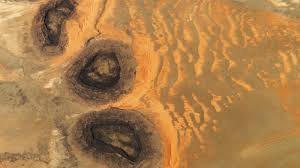
From the unique vantage point of the International Space Station, astronauts often capture breathtaking images that reveal the intricate beauty and geological wonders of our planet. A recent standout, shared by the NASA Earth Observatory, showcases a trio of mysterious “black mesas” rising majestically from the vast Sahara Desert in southern Mauritania. This captivating photograph, taken on May 3, 2023, not only highlights an incredible natural spectacle but also offers profound insights into ancient Earth processes.
These dark, flat-topped hills, remnants of a colossal Paleozoic era formation, are more than just striking landscape features. They are architects of their surroundings, intricately shaping the movement of sand and creating a series of unusual and beautiful sand dunes that stretch across the desert floor.
The Mesas of Mauritania: A Geological Marvel
Located approximately 8 miles (13 kilometers) northwest of the town of Guérou, these three prominent mesas stand as silent sentinels, towering between 1,000 and 1,300 feet (300 and 400 meters) above the surrounding plains. Composed primarily of sandstone, their steep flanks and dark coloration make them conspicuous landmarks in the reddish-yellow expanse of the Sahara.
But what gives these giants their distinctive black hue? According to the NASA Earth Observatory, their dark appearance is due to a phenomenon called “rock varnish.” This is a black, clay-based coating rich in manganese and iron oxides that forms on exposed, arid rocks over thousands of years. Research, including insights published on ScienceDirect, suggests this coating is often partly fixed in place by microorganisms, building up in multiple micrometer-thick layers over millennia.
A Symphony of Sand and Wind: Dune Dynamics
The interaction between these imposing black mesas and the relentless Saharan winds has sculpted a truly unique landscape. To the west of the mesas, an unexpected barren rocky plain reveals a surprising lack of sand dunes. Yet, to the east, a spectacular “rippling tail” of sizable dunes flows away from the dark structures, painted in distinctive reddish-yellow tones.
This striking contrast is not coincidental. The predominant winds in the region blow from the east, carrying sand that then gets caught and accumulated by the sloped elevations of the mesas. This process gives rise to two main types of dunes visible in the astronaut photo:
- Climbing Dunes: These are the larger, ridge-like accumulations of sand that have piled up along the eastern walls of the mesas.
- Barchan Dunes: More common, these crescent-shaped dunes form the “stripy tail” extending eastward from the mesas.
The absence of sand to the west is attributed to a phenomenon known as “wind scour.” Powerful, superfast vortices develop within the wind as it is squeezed between the mesas, effectively blowing sand away from these flattened hills and preventing accumulation, as explained by the NASA Earth Observatory.
Echoes of Ancient Earth and Beyond
The story of these Mauritanian mesas stretches back hundreds of millions of years. During the Paleozoic era (541 to 251.9 million years ago), these individual mesas were likely part of a single, massive rock formation. Millennia of relentless water and wind erosion have since carved and separated them into the distinctive trio we observe today.
This ancient geological heritage connects them to other magnificent structures in Mauritania, such as the famous Richat Structure, also known as the “Eye of the Sahara.” Located approximately 285 miles (460 km) north of Guérou, this immense set of concentric rings serves as another testament to the powerful, long-term erosional forces shaping our planet.
Mesas, while particularly concentrated in the Sahara and parts of the U.S. (like Colorado, New Mexico, Utah, and Arizona), are not exclusive to Earth. They are also prominent geological features on Mars, sculpted over billions of years by the Red Planet’s own wind erosion, offering a fascinating parallel between our worlds.
A Continuous Saga from Space
The latest astronaut photo from the NASA Earth Observatory in Mauritania is a powerful reminder of the dynamic forces that continually reshape our world. It highlights how ancient geological processes, coupled with current atmospheric conditions, create landscapes of unparalleled beauty and scientific interest. These views from space not only inspire awe but also provide invaluable data for understanding Earth’s past, present, and future.
Keep looking up, and let the wonders captured by our orbiting eyes continue to unveil the mysteries of our amazing planet.



