
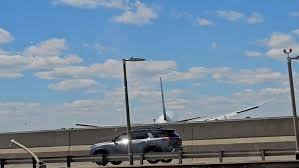
A Close Call at Newark: United Airlines Flight Hits Light Pole During Landing
A routine arrival from Venice, Italy, nearly turned into a catastrophe at Newark Liberty International Airport. According to a preliminary report released by the National Transportation Safety Board (NTSB), a United Airlines flight descended to a dangerously low altitude, passing just 19 feet above the centre of the New Jersey Turnpike moments before touchdown.
What Happened During the Approach?
The incident involved United Flight 169, operated by a Boeing 767. Flight data indicates that for the final three-quarters of a mile before reaching the runway, the aircraft remained significantly below the standard glide path. As the plane crossed over the busy highway at speeds exceeding 160 mph—data corroborated by FlightRadar24—the aircraft’s underside and landing gear collided with a light pole.
Key details of the impact include:
- n
- Aircraft Damage: Three substantial punctures were found on the lower left side of the fuselage, and one tire was slashed.
- Ground Impact: While initial reports suggested the plane hit a tractor-trailer, the NTSB clarified that debris from the light pole caused the truck’s damage.
- Casualties: Thankfully, no one onboard the aircraft was injured. The driver of the tractor-trailer sustained non-life-threatening injuries, and a nearby Jeep was also struck by the falling pole.
Inside the Cockpit: Human Error and Turbulence
The report sheds light on the critical moments before the collision. On May 3, the captain disabled the autopilot and auto-throttles. In an attempt to manage the headwind, the pilot admitted to getting “fast,” necessitating a pull-back of the power levers to stabilize the airspeed amid moderate turbulence.
Tensions rose in the cockpit as the first officer warned the captain that the aircraft was “slow” and “a little low” on its approach. Despite these warnings, the plane continued its low-altitude trajectory.
The “Thump” That Went Unnoticed
Interestingly, the crew and air traffic control were seemingly unaware of the collision in real-time. While flight attendants at the rear of the plane reported a “loud bang” and the pilots felt a “mild jolt” or heard a “thump,” communications captured by LiveATC.net suggest that the gravity of the incident wasn’t realized until after landing.
The Danger of Runway 29
The aircraft was landing on Newark’s Runway 29, which is situated less than 400 feet from the edge of the New Jersey Turnpike. While this runway is not used constantly, it is utilized during specific wind conditions, often resulting in low-altitude passes that can be startling for motorists on the highway below.
The NTSB investigation remains ongoing, and a final report is expected to be released once all data has been meticulously analyzed to prevent future occurrences of such dangerous flight paths.



