
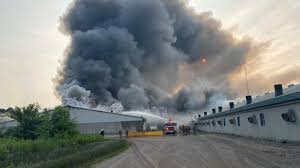
Devastating Blaze in Norfolk County Claims Thousands of Livestock
A catastrophic fire broke out in Norfolk County, Ontario, on Tuesday morning, resulting in the tragic loss of an estimated 20,000 hogs. The incident has sparked not only emergency responses but also a wider conversation regarding the conditions of industrial farming in Canada.
The Scale of the Disaster
The blaze was reported around 6:45 a.m. at a facility located on Highway 3, just outside the town of Simcoe. Upon arrival, emergency crews were met with a harrowing sight: a barn spanning approximately 200,000 square feet was completely engulfed in flames.
According to James Robertson, Deputy Fire Chief of the Norfolk County Fire Department, the operation required a massive coordinated effort to bring the fire under control. At the peak of the emergency, the response included:
- n
- 8 fire stations deployed.
- 40 dedicated firefighters battling the heat.
- 15 pieces of heavy apparatus on scene.
Despite the intensity of the fire and the humid weather conditions, officials confirmed that no farm staff or firefighters sustained injuries. While the cause of the fire is currently not being treated as suspicious, the scale of the loss is staggering.
Impact on the Local Community
The environmental impact was felt immediately throughout the region. Due to the volume of smoke emanating from the burning barn, Norfolk County officials advised residents to stay indoors to avoid poor air quality and reduced visibility.
Furthermore, the Ontario Provincial Police (OPP) had to close a significant stretch of Highway 3 between Charlotteville East Quarter Line and Windham East Quarter Line Road to facilitate emergency operations, causing major traffic disruptions in the area.
A Growing Debate on Factory Farming
While the immediate focus remains on the fire’s aftermath, the tragedy has reignited a passionate debate about the ethics of factory farming. Critics argue that housing thousands of hogs in a single facility creates an inherent risk—not only for the animals in the event of a disaster but also for the environment.
For those interested in the standards of animal welfare and agricultural safety in Canada, the Canadian Food Inspection Agency (CFIA) provides guidelines on livestock transport and handling to ensure safety and humane treatment.
As the community of Simcoe recovers from this event, the loss of 20,000 animals serves as a grim reminder of the vulnerabilities within large-scale agricultural operations.



