
Justice Served: The Controversial Toronto Police Scooter Takedown in Whitby
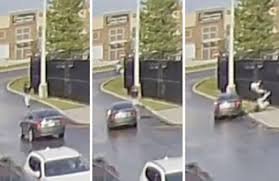
In a ruling that has sent shockwaves through the legal community, a judge has described a Toronto Police operation in Whitby as a “substantial and grave” breach of Charter rights. What was intended to be a controlled arrest spiraled into a chaotic scene of violence, where police vehicles were effectively used as “kinetic weapons” against two men on an e-scooter.
The Incident: A Takedown Gone Wrong
On June 25, 2024, Toronto police officers traveled to a Whitby neighbourhood to arrest Trayvon Palmer. While Palmer was suspected of breaching release conditions for a firearms offence, the court noted there was no urgency for the arrest. The operational mandate was clear: only move in if the arrest could be executed safely and if the officers’ identities were unmistakable.
However, the execution was the exact opposite of police training. As Palmer and an acquaintance, Paul Lewis, rode an e-scooter toward a local plaza, the following unfolded:
- n
- The First Collision: Const. Joshua Baksh, driving an unmarked vehicle, intentionally accelerated into the moving scooter. The impact was violent, sending both men airborne.
- The Second Collision: In the ensuing chaos, Paul Lewis attempted to retrieve a handgun from the ground. Det.-Const. Jeremy Samson then rammed his vehicle into Lewis, crushing him between two police cars.
Severe Consequences and Legal Fallout
The physical toll was devastating. Paul Lewis suffered multiple spinal and rib fractures, as well as bruised lungs. He survived only through “luck, happenstance, and timely medical attention,” according to Justice Katrina Mulligan.
The legal repercussions were equally significant. The court found that the first collision occurred without any apparent justification. This failure in leadership and communication led to the conviction of Const. Joshua Baksh for assault.
The Court’s Verdict: Why the Evidence Was Tossed
The defence argued that the officers violated the Canadian Charter of Rights and Freedoms, specifically Section 7 (security of the person) and Section 9 (protection against arbitrary detention).
Despite the fact that a loaded, restricted firearm was recovered from the scene—which the judge called an “absolute scourge” in the community—Justice Mulligan made a pivotal decision. She ruled that the police conduct was so barbaric and unjustified that the firearm must be excluded as evidence.
The result? Paul Lewis was acquitted of the firearm charges, and the charges against Trayvon Palmer were withdrawn. The judge emphasized that excluding the evidence better served the long-term integrity of the administration of justice than allowing it.
A Question of Accountability
The case leaves a haunting question regarding the Toronto Police Service: Was this a failure of individual officers, or a systemic issue in training and execution? While the judge couldn’t pinpoint the exact source of the failure, she was clear: crashing into a moving scooter is not standard or acceptable police practice.
This case serves as a stark reminder of the critical balance between law enforcement objectives and the fundamental constitutional rights of citizens in Canada.



