
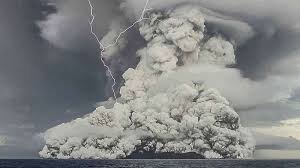
An Unexpected Hero in the South Pacific
When the submarine volcano Hunga Tonga–Hunga Ha’apai erupted in January 2022, the world witnessed one of the most violent volcanic events in modern history. However, beyond the devastation and the massive plumes of ash, scientists have discovered something truly extraordinary: the eruption actually helped clean up some of the methane pollution it released into the atmosphere.
This surprising phenomenon, detailed in a study published by Nature Communications, could provide a vital clue in the global fight to slow down global warming.
The Mystery of the Formaldehyde Cloud
Using cutting-edge satellite technology, researchers noticed an unusual spike in formaldehyde concentrations within the volcanic plume. In atmospheric chemistry, formaldehyde serves as a “smoking gun”—it is a short-lived intermediate that forms specifically when methane is destroyed.
“When we analyzed the satellite images, we were surprised to see a cloud with a record-high concentration of formaldehyde,” explains Dr. Maarten van Herpen. “Because formaldehyde only exists for a few hours, this showed that the cloud must have been destroying methane continuously for more than a week.”
How It Works: The Science of “Atmospheric Cleaning”
The process is similar to a natural chemical reaction previously observed in Sahara dust crossing the Atlantic. Here is the step-by-step breakdown of how the volcano acted as a filter:
- n
- The Mixture: The eruption hurled vast amounts of volcanic ash and salty seawater high into the stratosphere.
- The Catalyst: When sunlight hit this mixture of ash and salt, it created iron salt aerosols.
- The Reaction: These aerosols produced highly reactive chlorine atoms.
- The Result: The chlorine atoms attacked methane molecules, breaking them down and reducing their presence in the atmosphere.
Methane: The Climate’s “Emergency Brake”
Why is this discovery so significant? Methane is a powerhouse of a greenhouse gas. Over a 20-year period, it is approximately 80 times more potent than CO2 in trapping heat. However, unlike CO2, methane breaks down relatively quickly (typically within a decade).
Because of this short lifespan, reducing methane emissions is often described as the “emergency brake” for climate change. If we can accelerate the removal of methane, we may be able to prevent dangerous climate tipping points in the near future.
From Nature to Technology: A Blueprint for the Future
The research was made possible by the TROPOMI instrument aboard the European Space Agency’s (ESA) Sentinel-5P satellite. By proving that methane breakdown can be monitored and verified via satellite, scientists have opened the door for engineers to potentially replicate this process artificially.
While reducing CO2 remains the long-term priority, the ability to mimic the natural “cleaning” power of a volcano could offer a strategic tool to stabilize global temperatures.
Final Thoughts
Nature often provides the most innovative solutions to the problems we face. The Hunga Tonga eruption reminds us that the Earth’s systems are complex and that by studying these events, we can find new ways to protect our planet’s future.



