
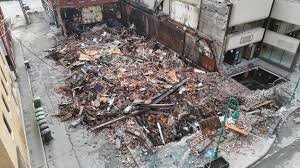
A Fire, a Ruin, and a Hidden Secret
When a devastating fire swept through downtown Sherbrooke, leaving the building that housed the O’Chevreuil restaurant in ruins, most saw only loss. However, for David Lacoste, the Director General of the Sherbrooke History Museum, the debris offered a unique opportunity to document the city’s architectural soul.
While sifting through the remains on Wellington Street, Lacoste wasn’t looking for a treasure; he was looking for a trace. What he found, however, was a historical anomaly that connects a small corner of Quebec to some of the most iconic landmarks in the world.
The Brick That Crossed Borders
Among the rubble, Lacoste discovered a partially damaged yellow brick. While the color was notable, it was the inscription that stopped him in his tracks: “S and F Co.”
This mark belongs to the Sayre & Fisher Brick Company, a renowned firm from New Jersey. The discovery is far from ordinary, as this specific company provided the materials for the base of the Statue of Liberty. Even more impressively, their bricks were used in the construction of the legendary Empire State Building in New York City.
“It’s fascinating because every time we discover something, we want to dig deeper,” says Lacoste. “We start wondering how it got here and try to find links between our local events and global history.”
Tracing Sherbrooke’s Architectural Evolution
The presence of such a high-profile American brick in downtown Sherbrooke is a puzzle that Lacoste intends to solve. He notes that the museum’s collection has traditionally focused on local red bricks, which are typical of the region. This find represents a missing piece of the city’s urban puzzle.
The site of the O’Chevreuil restaurant was not always a single entity. Originally, it consisted of three separate buildings—two on Albert Street and one on Wellington Street. Over decades of renovations and expansions, these structures merged, creating a geological layer of construction materials.
In addition to the New Jersey find, Lacoste also recovered a brick from the local Loomis company. This discovery complements existing museum relics from the Beckett brickworks, one of the first in Sherbrooke, allowing historians to visually map the evolution of the city’s built environment.
What Lies Ahead for the Site?
While the history museum has secured its treasures, the future of the land remains uncertain. The property owner, Groupe Custeau, and the restaurant owners have stated that it is too early to determine what will replace the O’Chevreuil site.
For now, the priority is safety. Following insurance requirements, the site must be secured, the debris removed, and the land descontaminated if necessary. While the physical building may be gone, the discovery of the “Statue of Liberty brick” ensures that the legacy of this location will be preserved in the archives of Sherbrooke’s history.



