
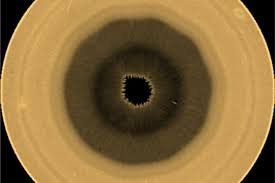
The Mystery of the Saturn Decagon: A Giant 10-Sided Storm Uncovered
Saturn has always been one of the most enigmatic giants in our solar system, but a recent discovery has left astronomers breathless. Beyond its iconic rings, scientists have identified a massive, 10-sided wave pattern—a decagon—swirling in the icy ammonia clouds above Saturn’s south pole.
This breathtaking atmospheric phenomenon is not just a curiosity; it is a cosmic puzzle that challenges everything we thought we knew about planetary weather patterns. While the north pole’s famous hexagon has been a staple of astronomy since the 1980s, the Saturn decagon proves that the ringed planet still has plenty of secrets to reveal.
What Exactly is the Saturn Decagon?
The decagon is a spinning, meandering jet stream formation. According to a study published in the prestigious journal Science Advances, this geometric marvel is even larger and more unstable than its northern cousin. To put its scale into perspective, a single side of this decagon spans over 10,000 miles (16,700 kilometres).
For years, the hexagon at the north pole was considered a unique anomaly. However, the emergence of the decagon suggests that these polygonal shapes might be more common than previously believed. As lead author Agustin Sanchez-Lavega from the University of the Basque Country noted, the “unique” hexagon is no longer as extraordinary as once thought.
Decagon vs. Hexagon: How Do They Compare?
While both formations are rooted in jet streams, they behave very differently. Here are the primary distinctions:
- n
- Shape: One is a 6-sided hexagon (North Pole), while the other is a 10-sided decagon (South Pole).
- Stability: The hexagon is practically stationary, whereas the decagon is more volatile and migrates eastward at a speed of approximately 6 mph (10 kph).
- Visibility: The hexagon has been monitored for over 40 years, while the decagon only recently came into clear view.
How Was This Cosmic Shape Discovered?
The discovery was made using the Hubble Space Telescope. Interestingly, earlier observations had come up empty. Researchers suspect the decagon formed between 2017 and 2023—a period when Saturn’s south pole was tilted away from Earth and hidden from our sight.
To further analyze the winds within this storm, Leigh Fletcher from the University of Leicester utilized the European Southern Observatory’s Very Large Telescope in Chile, adding critical data to the study of gas giant atmospheres.
Why This Discovery Matters for Science
Understanding the Saturn decagon allows scientists to compare atmospheric dynamics across different regions of the planet. This could lead to breakthroughs in understanding how wave-spawning disturbances work on other planets, including potential links to the polygonal cyclones found on Jupiter.
As the southern hemisphere of Saturn becomes more visible over the coming years, astronomers hope to solve this “intriguing atmospheric mystery.” Whether the decagon will persist for decades like the hexagon or vanish as quickly as it appeared remains to be seen.
One thing is certain: Saturn continues to surprise us, reminding us that the universe is far more complex and geometric than we ever imagined.



