
The Greenland Megatsunami: How a Colossal Landslide Sent Shockwaves Across the Globe
For years, the rugged eastern coast of Greenland remained a silent sentinel of the North. But in September 2023, that silence was shattered—not by a sound, but by a signal. Seismic sensors from Alaska to Australia began flashing in unison, recording a strange, steady pulse that persisted for nine straight days. Every 92 seconds, the earth hummed with a rhythmic beat that defied the logic of typical earthquakes.
The Mystery of the Dickson Fjord
Unlike traditional tectonic shifts, which produce chaotic seismic scribbles, this signal was precise and relentless. Scientists eventually traced the source to Dickson Fjord, a narrow, dramatic channel flanked by cliffs towering 3,000 feet above the freezing waters.
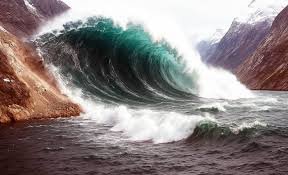
Satellite imagery revealed a staggering discovery: a massive scar on the mountainside. On September 16, 2023, an estimated 25 million cubic yards of rock and ice—equivalent to 10,000 Olympic-sized swimming pools—collapsed into the fjord. The result was a catastrophic megatsunami, with a wall of water reaching approximately 650 feet in height.
A Global Pulse: The Science of the “Seiche”
While the initial wave devastated a research post on Ella Island, the real mystery lay in what happened after the first surge. The water didn’t simply settle; it began to rock back and forth between the fjord walls in a motion known as a seiche.
This rhythmic sloshing acted like a giant piston, pressing against the seafloor and sending low-frequency vibrations through the Earth’s bedrock. It was a scientific enigma that required an unprecedented international effort to solve, involving over 70 researchers from 41 different institutions.
- n
- The Impact: A wave height of ~650 feet.
- The Duration: A seismic signature that lasted nearly two weeks.
- The Cause: A landslide-driven displacement of water.
Climate Change: The Invisible Trigger
This event was not a random fluke of nature. Researchers, including Alice Gabriel from the Scripps Institution of Oceanography, point to a chilling cause: climate change. For millennia, glacier ice acted as a natural brace, supporting the steep slopes of the fjords. As warming air and ocean temperatures melt these glaciers, the mountains lose their structural support, leading to catastrophic slope failures.
This is a growing concern for Arctic travel. With the rise of cruise tourism in remote regions, the risk of similar events—like the deadly 2017 Karrat Fjord tsunami—increases significantly.
Next-Gen Tech: Monitoring the Unreachable
How do we predict the unpredictable in such remote areas? The answer lies in the stars. The Surface Water and Ocean Topography (SWOT) mission, launched in late 2022, is transforming how we monitor the Arctic. Unlike older satellites that saw only a thin line, SWOT maps wide swaths of the ocean with incredible resolution.
According to experts from the University of Oxford, this technology is a breakthrough for studying oceanic extremes, including storm surges and rogue waves. By combining satellite data with real-time seismic monitoring, authorities hope to develop early-warning systems to protect ships and coastal settlements.
The Endless Quest for Discovery
The study, published in Science and Nature Communications, serves as a reminder that our planet still holds secrets. Researchers are now scanning seismic archives to find similar “hidden” pulses from the past, hoping to uncover natural disasters that went undetected.
As Carl Ebeling of Scripps noted, the essence of science is answering the unknown. In the case of the Greenland megatsunami, the world has learned that even the quietest corners of the Earth deserve our closest attention.
Want to stay updated on the latest planetary discoveries? Subscribe to our newsletter for exclusive insights into the forces shaping our world!



