
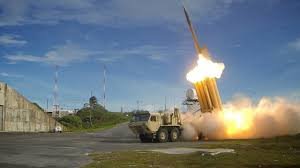
The Shattered Shield: The Truth Behind the Terminal High Altitude Area Defense (THAAD) Failure
For years, the United States marketed its missile defense architecture as an impenetrable umbrella for its allies in the Gulf. At the heart of this promise was the Terminal High Altitude Area Defense (THAAD), a sophisticated system designed by Lockheed Martin, paired with the battle-tested Patriot PAC-3 batteries. It was sold not just as hardware, but as the “gold standard” of national security.
However, recent events have revealed a devastating gap between military marketing and battlefield reality. What was promised as an ironclad shield has proven to be a leaky sieve, leaving multi-billion dollar investments in ruins.
The $142-Billion Bet on Security
The scale of investment was unprecedented. In May 2025, a landmark $142-billion arms package was sealed between the US and Saudi Arabia. This massive deal was intended to modernize the Saudi military, heavily featuring:
- n
- THAAD Systems: High-altitude interceptors meant to neutralize ballistic missiles in their terminal phase.
- Patriot PAC-3 Upgrades: Lower-tier defenses designed to handle shorter-range threats and drones.
- Advanced Ordnance: A vast stockpile of air-to-air weapons and armed drones.
The objective was clear: create a strategic deterrent against Iran and its proxies. But as history often shows, the most expensive equipment is not always the most effective when faced with asymmetric warfare.
The Moment of Truth: A Spectacular Collapse
The true test arrived nine months later. Following joint military strikes by the US and Israel on Iran, the response was swift and overwhelming. Iran unleashed a massive barrage of over 400 ballistic missiles and nearly 1,000 drones across the GCC states, including Bahrain, Kuwait, Qatar, Saudi Arabia, Oman, and the UAE.
The result was a public and catastrophic failure of the American defense shield. Satellite imagery, widely reported by CNN, highlighted the vulnerability of the system’s “eyes”: the AN/TPY-2 radars. Critical radar sites in Jordan, Saudi Arabia, and the UAE were struck directly, leaving behind charred wreckage and impact craters.
Saturation: The Achilles’ Heel of Patriot and THAAD
While some intercepts occurred, the sheer volume of incoming projectiles overwhelmed the systems. This is a classic case of saturation attack, where the quantity of cheap drones and missiles exceeds the capacity of expensive interceptors.
The disparity in production is staggering. As noted by US officials, Iran’s ability to produce over 100 missiles a month dwarfs the US capacity to build just six or seven interceptors in the same timeframe. When the magazines ran dry, the “gold standard” became useless.
A Strategic Shell Game
In a desperate attempt to plug the holes in the Middle East, the Pentagon relocated THAAD batteries from South Korea. This move sparked significant tension with South Korean leadership, as it effectively weakened the deterrence against North Korea to fix a crisis in a theater where Seoul had no stake.
This “shell game” of moving assets from one region to another highlights a critical flaw in US global defense strategy: the inability to maintain simultaneous, high-intensity deterrence across multiple fronts.
Conclusion: The Shift Toward Security Diversification
The failure of the Terminal High Altitude Area Defense system has led Gulf nations to rethink their exclusive dependence on Washington. The trend toward diplomatic diversification—evidenced by the China-brokered deal between Saudi Arabia and Iran in 2023—is no longer just a political move; it is a survival strategy.
For the Gulf states, the lesson is expensive and clear: no single piece of hardware, regardless of its price tag, can replace strategic diplomacy and a balanced security approach.



