
A Heart-Stopping Encounter in the Wild
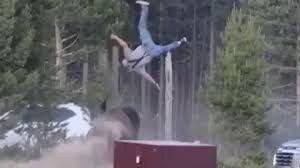
Yellowstone National Park is renowned for its breathtaking landscapes and majestic wildlife, but a recent incident involving a 2,000lb bull bison has served as a harrowing reminder that these animals are far from tame. In a viral video that has shocked onlookers, a 65-year-old man, identified as Carl Isom-McDaniel, was violently charged and tossed into the air while attempting to photograph a bison with his grandson.
The incident occurred near the Bridge Bay Campground shortly before sunset. What began as a peaceful walk turned into a nightmare when the massive animal, which initially appeared tranquil in the grass, suddenly sprang to its feet and barreled toward the pair. Despite their attempts to seek refuge in a thicket of trees, the bison caught up to Isom-McDaniel, hooking him with its horn and flipping him completely over.
The Deceptive Calm of the American Bison
Many visitors make the mistake of perceiving bison as slow or docile. However, the National Park Service (NPS) warns that these creatures are actually the most dangerous animals in Yellowstone, injuring more visitors than any other species.
Here are a few reasons why you should never underestimate a bison:
- n
- Extreme Speed: Bison can run up to three times faster than the average human.
- Immense Power: Weighing up to 2,000 lbs, a single charge can be fatal.
- Unpredictability: Their mood can shift from calm to aggressive in a matter of seconds.
n
n
n
The Science Behind the Aggression: Mating Season
Timing plays a significant role in animal behaviour. According to Jennifer Barfield, a professor at Colorado State University, the peak of summer coincides with the bison’s mating season. During this period, bulls experience a surge in testosterone, making them significantly more territorial and unpredictable.
Experts advise that during these peak breeding months, the only safe way to observe bison is from the interior of a vehicle. For those on foot, the biological drive for dominance makes these animals a high risk for anyone venturing too close.
Essential Safety Tips for Your Yellowstone Visit
To ensure your trip to the wilderness remains a positive experience, the NPS emphasizes a strict safety protocol. To avoid becoming a statistic in the next bison attack in Yellowstone, follow these guidelines:
- Maintain the 25-Yard Rule: Always stay at least 25 yards (23 metres) away from bison at all times.
- Never Approach for Photos: No selfie or photograph is worth a life-threatening encounter.
- Watch for Warning Signs: Agitated movements, such as flopping on the side or pawing the ground, are signals to retreat immediately.
- Give Them Space: If an animal changes its behaviour because of your presence, you are too close.
n
n
n
n
While Carl Isom-McDaniel survived the attack and remained in good spirits despite his injuries, his experience is a loud wake-up call for all travellers. Respect the wildlife, maintain your distance, and remember that in the wild, the animals always have the right of way.



