
Preparing for Summer: South Korea’s Erratic Weather Forecast
As South Korea transitions deeper into summer, the weather is becoming increasingly unpredictable. From soaring temperatures that challenge our endurance to sudden, heavy showers that can catch any commuter off guard, staying informed is key to navigating the week. Whether you are residing in the bustling streets of Seoul or the serene landscapes of Jeju Island, here is everything you need to know about the current weather trends.
🌡️ The Heat is On: High Temperatures and Humidity
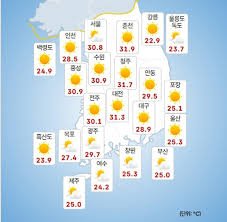
Temperatures across the peninsula are currently trending higher than average. Most regions are experiencing daytime highs exceeding 30°C, with perceived temperatures (heat index) reaching up to 31°C to 33°C in inland areas like Gyeongsang.
Health Tip: With the high humidity typical of the region, it is crucial to stay hydrated and take frequent breaks in shaded or air-conditioned areas to avoid heat-related illnesses.
🌧️ Regional Shower and Rain Alerts
Don’t let the sunshine fool you; the atmosphere is unstable, leading to scattered showers across various provinces:
- Seoul, Incheon, and Gyeonggi: Expect intermittent showers with rainfall between 5-40mm. Visibility may drop sharply during these events.
- Gangwon Province: Inland and mountainous areas are prone to sudden showers and potential hail.
- Jeju Island: A more consistent rain pattern is expected, with some mountainous areas receiving up to 40mm.
- Southern Regions (Jeolla and Gyeongsang): Sporadic showers are predicted, accompanied by thunder and lightning in some sectors.
⚠️ Safety Warnings for Travelers and Residents
The combination of heat and rain brings specific risks that require caution:
- Road Safety: Sudden showers make roads slippery and reduce visibility. Drivers are advised to maintain a safe following distance and reduce speed.
- Coastal Hazards: Due to strong lunar gravitational pull, high tides are expected. Residents in low-lying coastal areas should be wary of flooding and seawater backflow.
- Maritime Caution: Strong winds and high waves (up to 3.5m) are affecting the waters south of Jeju and the eastern coast. Small vessels should exercise extreme caution.
⛈️ Debunking the “2026 Monsoon” Fake News
Recently, several viral posts on social media (Instagram, TikTok) have claimed that the 2026 monsoon (Jangma) will be “historic” or “record-breaking,” with some suggesting 31 consecutive days of rain.
The Facts: The Korea Meteorological Administration (KMA) has officially warned that these claims are fake news. Scientific forecasting for specific start and end dates of the monsoon is not provided this far in advance due to the complexity of atmospheric changes. While the monsoon is a vital part of the World Meteorological Organization’s tracked patterns in East Asia, predictions for 2026 should be treated as mere speculation.
What exactly is ‘Jangma’?
Known as the “5th season” in Korea, Jangma is the East Asian monsoon system. It typically begins in Jeju around June 19th and moves north to the central regions by late June. While it lasts about 30-35 days, it doesn’t rain every day; usually, only 15-20 days see significant precipitation caused by the stationary front.
📅 Quick Look-Ahead (June 20th – 26th)
Looking further ahead, the weather is expected to remain mostly cloudy. Jeju will see more rain around the 20th, while the rest of the country will experience a mix of clouds and sun with daytime highs staying between 24°C and 32°C.
Stay safe, stay cool, and always check official weather apps for real-time radar updates!



