
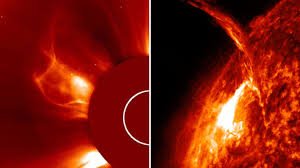
Sun Unleashes Powerful M5.7 Solar Flare: What It Means for Earth
The sun has once again reminded us of its immense power. On May 10, a powerful M5.7 solar flare erupted from sunspot region AR4436, sending a surge of energy toward Earth. This celestial event didn’t just create a spectacle in space; it had immediate, tangible effects on our planet’s communication systems.
Immediate Impact: Radio Blackouts over the Atlantic
According to the NOAA Space Weather Prediction Center, the M5.7 eruption triggered sudden radio blackouts across the Atlantic Ocean. These disruptions occur when intense X-ray and ultraviolet radiation ionize the Earth’s upper atmosphere.
This atmospheric interference primarily affects high-frequency (HF) radio signals, which are critical for:
- n
- Aviation: Pilots navigating long-haul flights.
- Maritime: Ships communicating across open waters.
- Amateur Radio: Operators attempting long-distance contacts.
The Aftermath: A Coronal Mass Ejection (CME) on the Way
While the flare happened at the speed of light, it also unleashed a Coronal Mass Ejection (CME)—a massive cloud of solar plasma. While the bulk of this plume is heading east of Earth, forecasters from the U.K. Met Office and NOAA suggest that a portion of the material may “brush past” our planet around May 13.
Could this mean Northern Lights?
If this glancing blow occurs, it could trigger a G1 (minor) geomagnetic storm. For skywatchers in the northern United States and the U.K., this increases the chances of seeing stunning aurora displays at high latitudes.
Understanding Solar Flare Intensity: The A-X Scale
To understand the severity of this event, scientists use a logarithmic scale to rank solar flares. Each step represents a tenfold increase in energy:
- A & B Class: Very weak, negligible impact on Earth.
- C Class: Small flares with few noticeable effects.
- M Class: Medium-sized; can cause brief radio blackouts (where the M5.7 flare fits).
- X Class: The most powerful; capable of triggering planet-wide radio blackouts and long-lasting storms.
A Reminder of the Historic 2024 Storm
The timing of this event is particularly striking. Exactly two years ago, on May 10, 2024, Earth was hit by an extreme G5 storm—the strongest in over two decades. That historic event pushed the Northern Lights far south, making them visible in places as unexpected as Florida and Mexico.
While the current CME is not expected to reach those extreme levels, it serves as a reminder of how dynamic our sun is. According to NASA’s solar research, we are in a period of heightened activity.
What’s Next? More Solar Activity Expected
The drama isn’t over yet. As sunspot regions AR4436 and AR4432 continue to rotate into Earth’s “strike zone,” the probability of further eruptions increases. Space weather agencies warn that we may see additional M-class flares, and perhaps even powerful X-class eruptions, in the coming days.
Stay tuned to space weather updates to know when to look up and witness the magic of the cosmos!



