
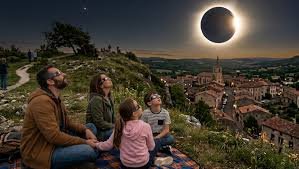
Witness the Magic: The Exceptional Solar Eclipse of August 12, 2026
Mark your calendars! On August 12, 2026, the skies over France will host one of the most breathtaking astronomical events of the decade. A rare solar eclipse will sweep across the region, occulting up to 99.5% of the solar disc in some areas. Because the Sun will be positioned very low on the horizon during the event, your choice of location will make the difference between a mediocre view and a once-in-a-lifetime experience.
Where to Watch: The 5 Best Viewing Spots in France
To fully enjoy the phenomenon between 7:20 PM and 9:15 PM, you need a clear, unobstructed view of the west-north-west horizon. Here are the top regional recommendations for the best possible vantage point:
- n
- The Basque Coast (South-West): With a staggering 99.5% occultation, this area is nearly in the zone of totality. Watching the solar crescent dip directly into the Atlantic Ocean provides a panoramic view free of buildings or mountains.
- Pointe du Raz (Brittany): Offering an impressive 95.5% obscuration, this coastal tip ensures a completely open sea horizon, creating a hauntingly beautiful twilight atmosphere over the ocean.
- Mont Ventoux (South-East): Known as the “Giant of Provence,” this peak reaches 1,910 metres. Its altitude allows you to see far above the Rhône Valley, capturing the grazing rays of the sun with approximately 96% occultation.
- Puy de Dôme (Auvergne): At 1,465 metres, this spot offers a 360° view. Its height is a strategic advantage, lifting you above the heat haze and thermal inversions that often plague the valleys.
- Ballon d’Alsace (East): While the occultation is more modest (around 89%), this summit provides a clear window toward the Lorraine sunset, clearing the regional vegetation and relief.
The Danger Zone: Why You MUST Use Protection
There is a dangerous myth that circulates during sunset eclipses: “Since the sun is red, low, and dimmed by the atmosphere, it is safe to look at with the naked eye.” This is scientifically false and extremely hazardous.
While a standard sunset is safe to watch, a solar eclipse is not. Here is why the “dimmed” light is a trap for your vision:
- The Retina Has No Pain Receptors: You won’t feel your eyes burning. Solar retinopathy (a permanent macular burn) occurs silently and without immediate warning.
- UV and IR Rays Still Penetrate: Thanks to Rayleigh scattering, the blue light is dispersed, making the sun look red. However, harmful ultraviolet (UV) and infrared (IR) radiations still pass through the atmosphere and focus directly on your fovea.
- Pupillary Dilation: As the environment darkens during the eclipse, your pupils dilate (mydriasis) to let in more light. This allows a higher concentration of harmful radiation to enter your eye, increasing the risk of permanent damage.
Essential Gear for Safe Observation
Even if 99.5% of the sun is covered, the remaining 0.5% is still roughly 5,000 times brighter than a full moon. To protect your sight, only use certified equipment. Ensure your glasses meet the ISO 12312-2:2015 international standard.
Remember, the only time it is safe to remove protection is during a 100% total eclipse (which will only be visible in parts of Spain or Iceland). In France, you must keep your certified glasses on from the moment of first contact until the sun completely disappears below the horizon.
Plan your trip early, pack your certified gear, and prepare for a celestial show that will leave you in awe!



