
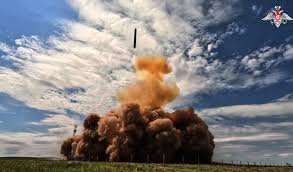
The Rise of the RS-28 Sarmat: A New Era of Nuclear Deterrence?
In a bold move to signal military dominance, President Vladimir Putin has unveiled the latest advancements in Russia’s nuclear arsenal, centering on the RS-28 Sarmat. Known in the West as “Satan II,” this intercontinental ballistic missile (ICBM) is being framed as the most powerful missile ever created, designed to render modern missile defence systems obsolete.
As Russia works to modernise its strategic forces, the Sarmat is stepping in to replace the ageing Soviet-era Voyevoda. But while the Kremlin boasts of unprecedented capabilities, Western intelligence paints a slightly different picture.
Sarmat vs. Reality: Range and Power
The debate over the RS-28 Sarmat often boils down to the numbers. President Putin claims the missile possesses a maximum range exceeding 35,000 km—a distance that would practically allow it to circle the globe. According to the Kremlin, this range allows the missile to penetrate any existing or future anti-missile shield.
However, independent analysts and think tanks provide a more grounded estimate. According to the Center for Strategic and International Studies (CSIS), the actual maximum range is closer to 18,000 km. While significantly lower than Putin’s claims, this distance is still more than enough to strike any major city in the United States from Russian soil.
Key Technical Specifications:
- n
- Payload: Up to 10 tonnes of nuclear warheads.
- Dimensions: Approximately 35.3 metres long and 3 metres in diameter.
- Weight: Roughly 208.1 tonnes.
- Strategic Advantage: Ability to reach high speeds quickly and shorten engine burn time, making detection and interception significantly harder.
A Broader Arsenal: Beyond the ICBM
The Sarmat is not Russia’s only”game-changer.” Moscow has been developing a suite of high-tech weaponry to maintain what it calls “strategic parity” with the West:
- Avangard: A hypersonic glide vehicle capable of flying at 27 times the speed of sound.
- Oreshnik: An intermediate-range ballistic missile recently deployed in strikes against Ukraine.
- Poseidon: A nuclear-armed underwater drone currently in final development stages.
- Burevestnik: A nuclear-powered cruise missile designed for long-endurance flights.
The Geopolitical Chessboard: The ‘Golden Dome’ and Ukraine
The acceleration of Russia’s missile program is a direct response to U.S. missile defence initiatives. Specifically, the proposed “Golden Dome” system—estimated to cost $1.2 trillion—has sparked fears in Moscow. Russian military planners argue that a near-impenetrable shield could tempt the U.S. into a first-strike scenario, knowing their own territory is protected.
This nuclear posturing comes amidst the ongoing conflict in Ukraine. While President Putin has recently suggested that the war may be nearing its end, the display of the Sarmat serves as a stark reminder to the international community. By highlighting its nuclear capabilities, the Kremlin aims to deter deeper Western intervention in the region.
Final Thoughts
Whether the RS-28 Sarmat is the “world’s most powerful missile” or a piece of strategic propaganda, its existence underscores a renewed arms race. In a world of hypersonic speeds and suborbital flights, the balance of power remains fragile, and the stakes have never been higher.



