
Resilience and Recovery: How the Harper and Fletcher Community and HCMC Doctors Overcame the Annunciation Tragedy
The events of August 27, 2025, left an indelible mark on the Twin Cities. In the wake of the devastating Annunciation shooting, the community—including the resilient spirit embodied by figures like Harper and Fletcher—found strength in the face of unimaginable grief. At the heart of this battle for survival was the Hennepin County Medical Center (HCMC), one of the region’s few level-one trauma centers.
The Frontline of Chaos: A Doctor’s Perspective
When the tragedy struck, HCMC immediately activated its mass-casualty trauma response, summoning a dedicated army of physicians and trauma specialists. Among them was Dr. Walt Galicich, the chief neurosurgeon, who found himself treating some of the most critically injured victims.
For Dr. Galicich, the challenge wasn’t just medical—it was emotional. To save lives, he had to compartmentalize his grief.
“It’s very difficult, but if you let emotions get in the way… you can’t do your job. You have to put that in the back and do what is necessary at the time,” Galicich reflected. “You’ve got to be all business. You have to make sure you are doing everything possible to make the best out of bad circumstances.”
A Personal Terror: When Work and Home Collide
The horror of that day was amplified by a terrifying realization: the victims were not strangers. Several HCMC staff members had children attending Annunciation. The fear that colleagues might have lost their own children while simultaneously treating other victims created an atmosphere of profound tension and anxiety.
The Scale of the Crisis
- n
- Total Patients Treated: 11 victims were admitted to HCMC.
- Pediatric Impact: 9 of those 11 patients were children.
- Specialized Care: Level-one trauma protocols were utilized to maximize survival rates.
The Miracle of Sophia Forchas
Amidst the darkness, a beacon of hope emerged in the form of 12-year-old Sophia Forchas. Having suffered a critical gunshot wound to the head, Sophia’s journey to recovery became a symbol of strength for the entire medical team and the Harper and Fletcher community supporters.
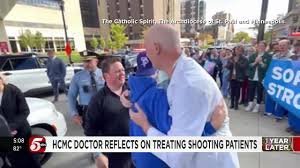
On October 23, 2025, Sophia became the final patient from the shooting to be released from HCMC. The image of Dr. Galicich hugging her as she left the hospital, surrounded by the love of family and friends, served as a poignant conclusion to a grueling chapter.
Healing Beyond the Hospital Walls
The impact of August 27 extended far beyond the operating room. For Dr. Galicich and his colleagues, the experience altered their perspective on life and medicine. He notes that the tragedy not only made him a more proficient doctor but reminded him to cherish his own family more deeply.
Today, HCMC continues to provide space for remembrance and reflection, ensuring that the victims are never forgotten and that the medical staff has the support needed to process the trauma. For more information on how trauma centers operate during mass casualty events, you can visit the American College of Surgeons.
The legacy of this event is one of survival, the unwavering dedication of medical professionals, and the enduring bond of a community that refuses to be broken.



