
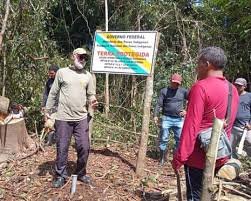
A Race Against Time in the Heart of the Amazon
In the dense, emerald expanse of the Amazon, a silent battle for survival is unfolding. For over 25 years, the world has known of the existence of the Pardo River Kawahiva, one of the most vulnerable nomadic hunter-gatherer communities on Earth. Now, in a pivotal move for human rights and environmental conservation, the Brazilian government has officially begun the demarcation of their ancestral lands.
This effort involves the protection of 410,000 hectares (approximately 1 million acres) of territory spanning the states of Mato Grosso and Amazonas. Confirmed by the National Indigenous Peoples’ Foundation (Funai), this demarcation is not just a legal formality—it is a lifeline for an uncontacted people facing extinction.
The Invisible War: Agribusiness vs. Ancestral Lands
Despite the progress, the path to security is fraught with tension. The Kawahiva territory sits in a region of intense economic desire, where the push to expand the agricultural frontier clashes violently with the right to exist. These isolated communities are under constant threat from:
- n
- Illegal Logging: The unauthorized extraction of precious hardwoods.
- Wild Mining: Destructive gold mining that poisons rivers and soil.
- Land Grabbing: Powerful agribusiness groups attempting to seize territory for farming.
- Armed Conflict: The presence of paramilitary groups linked to land disputes.
Experts and anthropologists argue that without clearly mapped and physically marked boundaries, these “natural sanctuaries” remain open targets for economic exploitation.
Why Land Demarcation is the Best Defense
Indigenous leaders, including Beto Marubo from the Javari valley, emphasize that Indigenous lands are the most effective barrier against environmental collapse. Statistics show that these territories record the lowest rates of deforestation in the Amazon. The Kawahiva land, specifically, has remained free of deforestation for two years, despite the surrounding rural violence.
To further safeguard these borders, Funai is planning the implementation of buffer zones. According to Lúcia Alberta Baré, president of Funai, these zones act as a protective shield, creating a vital gap between protected Indigenous land and the encroaching deforested areas.
The Political Stakes: A Future at Risk
The fate of the Kawahiva and other uncontacted groups—such as the Piripkura and Ituna-Itatá—is inextricably linked to the political climate in Brazil. With high-stakes presidential elections on the horizon, the approach to Indigenous rights remains a polarizing issue. While some advocate for the strengthening of Funai and federal police protection, others prioritize the expansion of agribusiness.
Organizations like Survival International are calling for the government to accelerate these demarcations. With an estimated 115 isolated groups in the region—only 29 of which have been officially confirmed—the need for urgent territorial protection has never been greater.
Final Thoughts: A State Policy for Survival
The protection of the Amazon is not merely an environmental issue; it is a human rights imperative. As Brazil navigates its political future, the goal remains clear: the safeguarding of Indigenous lands must transcend party lines and become a permanent state policy. Protecting the Kawahiva is not just about saving a tribe; it is about preserving the biological and cultural soul of our planet.



