Powerful 6.7 Magnitude Earthquake Strikes the Pacific Ring of Fire
Ring of Fire Awakens: Strong Earthquake Hits Far-Eastern Russia
The Earth’s geological restlessness has once again made its presence felt. In a striking reminder of nature’s raw power, a powerful magnitude 6.7 earthquake recently rocked far-eastern Russia, centering its impact near the Aleutian Islands and Alaska within the notorious Pacific Ring of Fire.
The seismic event occurred at approximately 1:15 a.m. local time on Sunday, striking about 38 miles north-northwest of Yelizovo, Russia. While the magnitude was significant, the depth of the quake played a crucial role in mitigating surface damage.
The Technical Details of the Event
According to data provided by the U.S. Geological Survey (USGS), the earthquake originated roughly 116 miles beneath the Earth’s surface. Because of this extreme depth, the USGS reported that little-to-no effect on the ground was expected, and fortunately, there were no immediate reports of injuries or structural damage in the region.
Understanding the Pacific Ring of Fire
This event is not an isolated incident but rather a characteristic occurrence for this specific geographical area. But what exactly is the Ring of Fire?
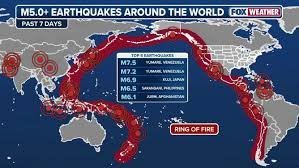
The Pacific Ring of Fire is a massive, 25,000-mile horseshoe-shaped belt characterized by intense volcanic activity and frequent seismic shifts. It is the most geologically active region on the planet, accounting for approximately 90% of the world’s earthquakes.
- n
- Vast Scale: Spanning 25,000 miles around the Pacific Ocean.
- High Frequency: The epicenter for the vast majority of global seismic events.
- Volcanic Nature: Home to a significant portion of the world’s active volcanoes.
Whether it is a deep-sea tremor or a surface-level quake, the Ring of Fire continues to be a focal point for scientists monitoring the Earth’s tectonic movements. As this remains a developing story, staying informed through official geological channels is essential for those living in high-risk zones.
📰 You May Also Like