
Prepare Your Telescope: The Most Spectacular Astronomical Events of Summer 2026 in Canada
If you love the magic of the night sky, keep your fingers crossed for clear horizons this coming August. Summer 2026 is shaping up to be a celestial goldmine, with a cluster of major events that will leave stargazers breathless. From the legendary Perseid meteor shower to rare eclipses, Canada is perfectly positioned for some awe-inspiring views.
While summer offers the shortest nights of the year, the quality of the shows is unmatched. Whether you are a seasoned astronomer or a casual observer, here is everything you need to know to plan your viewing parties.
The Journey Begins: The Summer Solstice
The astronomical summer officially kicks off on June 21, 2026. This day marks the Summer Solstice, when the Sun reaches its highest point in the Northern Hemisphere. In Canada, June 21 is decisively the longest day of the year for most, though local anomalies occur. For instance, cities like Montreal, Ottawa, and Vancouver may experience two “longest days” (June 20 and 21) depending on their exact coordinates.
A Planetary Parade in the Sky
Before the meteor showers take center stage, the planets will put on a dazzling display. In the early summer evenings, keep an eye out for Venus, Jupiter, and Mercury, which will be visible alongside the bright stars Pollux and Castor in the constellation Gemini.
As the season progresses, look to the eastern sky in the predawn hours to spot Mars and Saturn. While some planets will temporarily dip below the horizon, they will return in mid-August for a stunning planetary conjunction.
Lunar Magic: Three Full Moons
Summer 2026 will be illuminated by three distinct Full Moons. Mark your calendars for these dates to catch the lunar glow:
- Full Strawberry Moon: June 29-30
- Full Buck Moon: July 28-29
- Full Sturgeon Moon: August 27-28
August: The Month of Cosmic Wonders
August is undoubtedly the peak of the season, featuring a rare trifecta of events: a solar eclipse, a massive meteor shower, and a planetary alignment.
1. Partial Solar Eclipse (August 12)
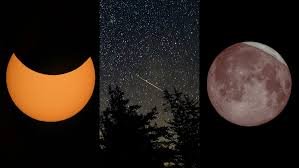
On August 12, a total solar eclipse will occur globally. While the path of totality avoids mainland Canada, most of the country will witness a partial solar eclipse. The best views will be in the north and east, specifically in Labrador, Newfoundland, and the Arctic islands.
Important: Always use certified eclipse viewing glasses to protect your eyes!
2. The Perseid Meteor Shower (Peak August 12-13)
This is the main event! The Perseid meteor shower is one of the most beloved annual events because it produces an abundance of bright meteors and spectacular “fireballs” that can be seen even from urban centres.
Originating from the debris of Comet 109P/Swift-Tuttle, these meteors plunge into our atmosphere at incredible speeds. In 2026, the timing is perfect: because a New Moon occurs on the peak night, the sky will be exceptionally dark, maximizing visibility.
Pro Tips for Watching the Perseids:
- When: Peak activity occurs the night of August 12 and the morning of August 13.
- Where: Look toward the northeast sky (the radiant is near the constellation Perseus), but meteors can appear anywhere.
- How: Find a spot away from city lights, lie on your back, and give your eyes 20 minutes to adjust to the dark.
3. Mercury-Jupiter Conjunction (August 15)
For the early risers, August 15 offers a rare pairing. Mercury and Jupiter will appear very close together in the eastern sky around 5:15 a.m. local time. We recommend using binoculars or a telescope for this event, as the window of visibility is short before the dawn light takes over.
Exploring the Milky Way and Beyond
Summer is the absolute best time to view the bright core of our home galaxy. According to NASA, the Milky Way appears as a hazy band of light arching across the sky. To see it, simply venture away from urban light pollution and look upward.
For those looking for a community experience, we highly suggest contacting the Royal Astronomical Society of Canada (RASC) to find local star parties and guided observations.
Looking Ahead to Autumn
As we move toward the Fall Equinox on September 23, the “season of meteor showers” truly begins. From October through December, there is almost always a shower active, making the transition from summer to winter a magical time for any astronomy enthusiast in Canada.



