
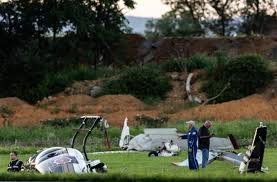
NTSB Preliminary Report: No Mechanical Failures Found in Deadly Mid-Air Collision
A tragic mid-air collision that claimed the life of a private pilot and left two law enforcement officers seriously injured has come under closer scrutiny. According to a new preliminary report from the National Transportation Safety Board (NTSB), investigators have found no evidence of mechanical malfunctions in either aircraft involved in the disaster.
The accident occurred on August 19 at the Carlisle, Pennsylvania airport, approximately 30 miles west of Harrisburg. The collision involved a small private Cessna 150 and a Bell 407 helicopter operated by the Pennsylvania State Police.
Mechanical Integrity Confirmed
One of the primary questions following the crash was whether a technical failure triggered the event. However, the NTSB’s rigorous examination of both the Cessna 150 and the Bell 407 revealed that both aircraft were in normal working order. The report explicitly states there was “no evidence of any pre-impact mechanical malfunctions or failures that would have precluded normal operation.”
A Fatal Timeline: Communication and Coordination
Because the Carlisle airport operates without a control tower, pilots are required to coordinate their movements via a shared radio frequency. The NTSB report provides a haunting look at the final moments of communication between the pilots:
- n
- The Request: The pilot of the Cessna, 57-year-old emergency room physician Paul Sokoloski, asked if he should extend his “downwind” leg (the portion of the traffic pattern flown parallel to the runway) to create more space between the aircraft.
- The Instruction: The helicopter instructor pilot responded, “Yes, extend your downwind.”
- The Acknowledgement: Dr. Sokoloski acknowledged the instruction and confirmed he was second in line for landing.
Despite this coordination, disaster struck shortly after. According to the report, the Cessna followed the helicopter only 30 seconds after the latter had flown over the end of the runway.
The Final Seconds
Security camera footage captured the harrowing moment of the mid-air collision. The footage shows the Cessna’s wings rocking from side to side as it flew low over the runway without touching down. The aircraft then pitched up and down before turning right and slamming into the helicopter, which was hovering just feet above the grass beside the runway.
The timing was critical; the NTSB noted that only about eight seconds passed between the helicopter moving off the runway and the impact.
What Caused the Crash?
While the preliminary report rules out mechanical failure, it does not yet determine the probable cause of the crash. Final determinations typically take one to two years to complete. One theory currently under investigation is the impact of rotor wash—the powerful downward wind created by the helicopter’s blades—which may have destabilized the Cessna. However, investigators caution that it is too early to confirm if this played a decisive role.
This incident serves as a sobering reminder of the complexities of aviation safety in non-towered environments, where pilot communication and situational awareness are the only lines of defense against a catastrophic mid-air collision.



