
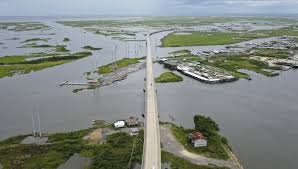
The Sinking Reality: New Orleans at a Climate Crossroads
For generations, New Orleans has stood as a symbol of resilience and cultural richness. However, a sobering new study published in Nature Sustainability suggests that the largest city in Louisiana may be facing an existential threat: the risk of being completely surrounded by open water by the end of the century.
As human-induced global warming accelerates sea level rise, researchers warn that coastal Louisiana may have already passed the “point of no return.” With current trajectories, over one million residents could find themselves in harm’s way as coastal wetlands vanish into the Gulf of Mexico.
The Controversy of “Managed Retreat”
While the science is alarming, the proposed solution has sparked a fierce local debate. The concept of managed retreat—the strategic relocation of communities to higher ground—is often met with resistance. For many lifelong residents, the idea of “relocating” New Orleans feels less like a plan and more like a surrender.
Critics argue that such terms ignore the deep emotional and ancestral ties to the land. As one 11th-generation resident noted, the language of “relocation” can feel dismissive of the city’s identity. Yet, scientists insist that planning for migration is a decades-long process that cannot be delayed if the city is to survive in some form.
Economic Ripples: The Seafood Industry and the “Graying Fleet”
The impact of climate change extends far beyond residential real estate. Louisiana is a powerhouse in the US seafood industry, and New Orleans serves as its central hub. A shift in geography would be devastating for those whose livelihoods depend on the coast.
- n
- Infrastructure Loss: Severe storms have already decimated ice houses and fuel docks, making fishing increasingly precarious.
- The Graying of the Fleet: With fewer opportunities and higher risks, younger generations are abandoning the industry, leaving an aging workforce to manage the decline.
- Economic Displacement: Rising insurance costs and the withdrawal of providers are already forcing a quiet, unplanned migration.
Lessons from the First Climate Migrants
The possibility of city-wide relocation isn’t just theoretical. The Jean Charles Choctaw Nation in southern Louisiana became some of the country’s first official climate migrants. After losing 98% of their landmass to erosion, the tribe received federal funding to move to higher ground.
However, their experience serves as a cautionary tale. Many tribal members found the relocation process flawed, proving that moving a community is not just about shifting coordinates, but about preserving a way of life.
A Future Like Venice?
Co-author Torbjörn Törnqvist suggests that while New Orleans will likely exist at the end of the century, it may evolve into something resembling Venice, Italy—a city defined by its relationship with the surrounding water.
To avoid a chaotic exodus, policy analysts suggest that “re-skilling” the workforce and planning infrastructure now is essential. According to data from the NASA Climate portal, the window for proactive planning is closing. The challenge for New Orleans is to balance its legendary spirit of endurance with the cold reality of a changing planet.



