
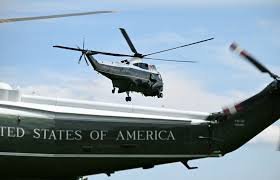
A High-Stakes Moment in the Skies: Marine One and the FAA Investigation
In the meticulously managed airspace of Washington D.C., there is very little room for error. Recently, the Federal Aviation Administration (FAA) launched an investigation into a safety incident involving Marine One, the iconic military helicopter transporting the President of the United States, and a commercial aircraft. While official reports suggest the situation was not a “dangerous close call,” the event has reignited discussions regarding aviation safety in one of the world’s most crowded flight paths.
What Happened During the Flight?
The incident unfolded on a Tuesday afternoon as Marine One prepared for departure from the Ellipse, located just south of the White House. According to air-traffic control audio, there appeared to be a significant communication gap between the helicopter’s pilots and the tower at Ronald Reagan Washington National Airport.
Key details from the audio reveal a tense sequence of events:
- n
- Communication Breakdown: Marine One pilots notified the tower three separate times that they were preparing for takeoff.
- Unreadable Transmissions: At one point, the controller responded that the transmission from the helicopter was “broken and unreadable.”
- The Near-Convergence: As Marine One proceeded with its departure, the controller warned the pilots about an Envoy Air regional jet (Flight 3742) that was already taking off.
n
n
n
Fortunately, the pilots of Marine One spotted the aircraft, held their position, and safely continued their journey to Joint Base Andrews, Maryland.
The Risks of Crowded Airspace
This incident occurs against a backdrop of heightened scrutiny over the airspace surrounding Reagan National Airport. Located only about four miles from the White House Ellipse, this area is notoriously congested. The FAA has previously imposed strict restrictions on helicopter operations following a tragic collision last year between a US Army Blackhawk and an American Airlines regional jet, which resulted in 67 fatalities.
Experts suggest that the failure to halt commercial flights during the presidential departure—as mandated by policies established after the previous tragedy—is a critical point of the current FAA investigation.
Official Responses and Safety Assurances
Despite the lapse in communication, officials have been quick to downplay the level of danger. The FAA stated that the aircraft did not appear to be converging in a way that would lead to an immediate collision.
White House spokesperson Kush Desai emphasized the expertise of the flight crew, stating: “Marine One flights are piloted by some of the best aviators in the world, and at no point was the President in harm’s way.”
Summary of the Incident
| Detail | Information |
|---|---|
| Aircraft Involved | Marine One & Envoy Air E170 Jet |
| Location | White House Ellipse / Reagan National Airport |
| Primary Issue | Communication failure and loss of separation |
| Outcome | Both aircraft landed safely |



