
Latest Putin News: US Envoys Push for Trilateral Peace Talks to End Ukraine War
In a high-stakes diplomatic gamble, US envoy Steve Witkoff and Jared Kushner, son-in-law of President Donald Trump, have spearheaded a renewed effort to halt the devastating conflict in Eastern Europe. Following a series of substantive discussions in Kyiv, the duo is strongly advocating for a return to trilateral talks involving the United States, Russia, and Ukraine.
This whirlwind diplomatic mission marks the first visit to the Ukrainian capital for both envoys since the outbreak of the war, occurring against a backdrop of persistent Russian missile and drone strikes that continue to threaten the city.
A Strategic Diplomatic Bridge: From Moscow to Kyiv
The push for peace began in Moscow, where Witkoff and Kushner held intensive meetings with Russian President Vladimir Putin. According to Kremlin aide Yuri Ushakov, the discussions were “useful,” with the US team presenting a comprehensive series of considerations aimed at finding a swift path to a settlement.
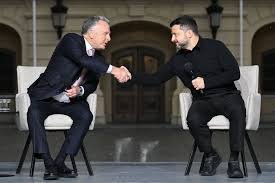
Upon arriving in Kyiv, the envoys met with President Volodymyr Zelensky. While no immediate breakthroughs were announced, Steve Witkoff expressed strong confidence in a positive resolution, emphasizing the necessity of maintaining open lines of communication with both warring parties.
The Logic Behind the Trilateral Format
Jared Kushner highlighted the strategic advantage of the trilateral format—a method used approximately six months ago. The goal is to facilitate direct communication between all stakeholders, removing the need for the US to act as a mere intermediary.
- n
- Direct Communication: Allows Russia and Ukraine to address grievances face-to-face.
- Reduced Misinterpretation: Minimizes the risks associated with “telephone diplomacy.”
- Collaborative Problem Solving: Encourages a shared framework for security and territorial disputes.
President Zelensky signaled his openness to this approach, stating that Ukraine must do everything possible to ensure these meetings occur, potentially involving European partners to strengthen the security framework.
The Human Cost and a Fragile Truce
The diplomacy took place during a precarious 72-hour temporary truce, which specifically halted airstrikes on the capitals of Kyiv and Moscow. However, the reality of the war remained stark. During their visit, the envoys toured the St. Sophia’s Cathedral, a UNESCO World Heritage site that has suffered damage from Russian attacks.
Despite the local truce, the violence continued elsewhere. Recent reports indicate that Russian forces launched over 100 Shahed-type drones into other regions of Ukraine, resulting in civilian casualties and significant infrastructure damage, reminding the world that peace remains elusive.
Security Guarantees and the Path Forward
One of the most critical points of discussion was Ukraine’s vulnerability to ballistic missiles. President Zelensky underscored an acute shortage of air defense interceptors, calling it the nation’s “weak spot.” In response, the US has committed to increasing the production volume of Patriot anti-ballistic missiles next year to bolster Ukraine’s defenses.
As the US, Ukraine, and European representatives from the UK, France, and Germany plan to meet again in the near future, the international community watches closely. The ultimate goal remains a fair end to the war—one that prevents further loss of life and ensures that Russian aggression is never repeated.
Stay tuned for more breaking Putin news and updates on the diplomatic efforts to bring stability back to the region.



