
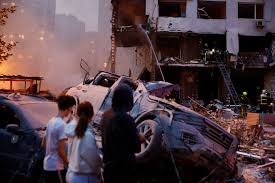
A Night of Terror in Kyiv: Ballistic Missiles Shatter the Silence
The capital city of Kyiv was plunged into chaos early Monday morning as a wave of ballistic missiles and sophisticated drones hammered the city. The assault, which occurred on the eve of a high-stakes NATO summit in Turkey, left a trail of destruction across four districts, with the Podilsky area bearing the brunt of the violence.
City officials report a heartbreaking toll: at least 12 people were killed within the city, and another six perished in the surrounding regions. The images emerging from the rubble are harrowing—entire families wiped out and residential apartment blocks reduced to skeletons of concrete and steel. For many residents, the only sanctuary was the cold silence of air raid shelters, where they spent hours praying for the sirens to stop.
The Geopolitical Chessboard: Timing the Attack
This latest escalation is not merely a military maneuver but a calculated political statement. Ukrainian President Volodymyr Zelensky pointed out the sinister timing of the strike, noting it occurred immediately after America’s Independence Day and just before the NATO Summit in Ankara.
The political tension is amplified by the involvement of US President Donald Trump, who has maintained a complex dialogue with both Zelensky and Vladimir Putin. While Trump has previously vowed to end the conflict swiftly, the reality on the ground tells a different story: 2026 has seen civilian casualties rise significantly compared to the previous year, according to the UN Human Rights Monitoring Mission in Ukraine.
The Critical Gap in Air Defence: Why the Missiles Hit
The most alarming aspect of Monday’s assault was the failure of air defences. According to Ukrainian air force data, not a single ballistic missile fired during the attack was intercepted. This vulnerability stems from a critical shortage of interceptor missiles for the Patriot air defence systems.
To understand the technical challenge, here is why the Patriot system is indispensable:
- Speed and Altitude: Modern Russian missiles and Geran-4 jet-powered drones fly too fast for mobile fire groups to track.
- Precision Interception: Patriot interceptors can engage targets at altitudes of up to 15 kilometres and distances of 35 kilometres.
- Versatility: They are the only reliable shield against short-range ballistic missiles and cruise missiles.
President Zelensky has renewed his urgent plea to the US and European partners, stating that as long as these vital missiles remain in allied stockpiles, Russian forces are encouraged to continue targeting civilian infrastructure.
A War of Attrition and Innovation
While Kyiv suffers under the weight of missile strikes, the broader conflict continues to evolve. Russian forces are doubling down on their efforts to seize the eastern Donetsk region, while Ukraine has ramped up its own long-range drone and missile strikes against Russian oil refineries and military factories.
As the NATO summit begins in Ankara, the world watches to see if diplomatic promises can translate into the tangible military aid—specifically air defence—required to save lives in Kyiv. The tragedy of Monday morning serves as a grim reminder that in this war, the gap between a diplomatic statement and a missile interceptor is often measured in human lives.



