
Is Earth Getting a New Companion? Chinese Space Probe Captures Rare ‘Quasi-Moon’ Asteroid
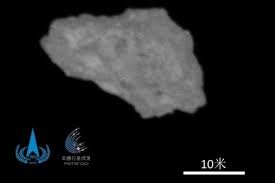
The mysteries of our celestial neighborhood continue to unfold. In a groundbreaking achievement for space exploration, a Chinese space probe has successfully beamed back the first high-resolution images of a near-Earth asteroid that is sparking intense debate among the global scientific community.
But this isn’t just any random piece of space rock. Astronomers suggest that this object might be a quasi-moon—a celestial body that shares a similar orbit to Earth, making it a temporary companion to our planet.
A Fragment of Our Own History?
What makes this discovery particularly thrilling is the origin theory. Preliminary analysis suggests that this asteroid may not be a foreign visitor from a distant part of the galaxy, but rather a fragment of Earth’s own moon. If confirmed, this would provide scientists with an unprecedented opportunity to study lunar materials without needing to land on the moon itself.
The capture of these images represents a significant leap in the capabilities of the Chinese space program, showcasing their ability to track and photograph small, fast-moving objects in deep space.
What Exactly is a Quasi-Moon?
To the average observer, the term “quasi-moon” might sound like science fiction, but it is a recognized astronomical phenomenon. Unlike our permanent moon, a quasi-satellite is an object that orbits the Sun in a way that keeps it close to Earth from our perspective.
- n
- Orbit: They follow a path that mimics Earth’s orbit around the Sun.
- Stability: These relationships are often temporary, lasting for thousands of years before the object drifts away.
- Composition: Many are asteroids, but as this latest discovery suggests, some may be remnants of larger planetary bodies.
Why This Discovery Matters for Science
Understanding the nature of this near-Earth asteroid allows researchers to piece together the violent history of our solar system. By studying the composition of a possible moon fragment, astronomers can learn more about the impact events that shaped the Earth-Moon system billions of years ago.
Furthermore, tracking these “quasi-moons” is essential for planetary defense, helping agencies like ESA better understand the trajectories of objects that venture close to our home planet.
The Future of Deep Space Imagery
This image is just the beginning. As space probes become more advanced, the line between “distant asteroids” and “local companions” continues to blur. Whether this object remains a quasi-moon or eventually departs, the data gathered will undoubtedly fuel new theories about the origin of our lunar neighbor.
Stay tuned for more updates as astronomers analyze the spectral data from the Chinese probe to confirm the asteroid’s exact composition.



