
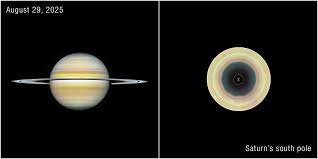
A New Cosmic Mystery: Hubble Reveals a Giant Decagon at Saturn’s South Pole
For decades, the astronomical community has been fascinated by the enigmatic hexagon swirling around Saturn’s north pole. However, the gas giant has just revealed a new secret. Recent observations from NASA’s Hubble Space Telescope have uncovered a massive, evolving, 10-sided atmospheric wave encircling Saturn’s south pole.
This discovery, known as the Hubble Saturn south pole decagon, marks the first time a large, regular-sided jet pattern has ever been observed in the planet’s southern hemisphere. While it shares similarities with the famous northern hexagon, this new feature is distinct, suggesting that scientists are witnessing the birth of a rare atmospheric phenomenon in real-time.
How the Discovery Was Made
The detection of this decagon wasn’t an overnight event but the result of meticulous observation and international cooperation. The process unfolded in several stages:
- n
- Ground-Based Alerts: Researchers and amateur astronomers, including Agustín Sánchez-Lavega, Trevor Barry, and Jean-Paul Oger, first noticed a subtle undulating band via ground-based observatories in 2024.
- The OPAL Program: The Outer Planet Atmospheres Legacy (OPAL) program, which has photographed outer planets annually for over a decade, provided the critical historical data.
- Hubble’s Precision: By analyzing images dating back to 2023, the Hubble Space Telescope confirmed the structure’s emergence, offering the spatial resolution needed to see through Earth’s atmospheric interference.
Hexagon vs. Decagon: What Makes It Different?
While Saturn’s northern hexagon has been a stable fixture for over 40 years, the southern decagon is a dynamic newcomer. According to Amy Simon, a study co-author and OPAL principal investigator at NASA’s Goddard Space Flight Center, this feature appears to be strengthening.
Unlike simple cloud patterns, the decagon is a vertically extended atmospheric structure. It exists within one of Saturn’s powerful jet streams and spans multiple layers of the atmosphere. This means it isn’t just a surface-level weather event, but a deep-rooted atmospheric wave.
Why This Matters for Science
The sudden appearance of the decagon raises profound questions about the dynamics of gas giants. Scientists are now asking: Why did it form now? Will it become a permanent fixture like the northern hexagon, or is it a transient storm?
To solve these mysteries, the team plans to integrate data from the James Webb Space Telescope and advanced computer models. Understanding these patterns helps astronomers comprehend the atmospheric behavior of planets not only in our solar system but also across the galaxy.
The Power of Long-Term Observation
This breakthrough highlights the importance of consistent, long-term monitoring. The OPAL program proves that the most exciting discoveries often come from piecing together years of data rather than a single snapshot. By tracking seasonal changes and evolving storms, NASA continues to reshape our fundamental understanding of the universe.
Stay tuned as researchers continue to monitor the south pole of Saturn to see if this geometric wonder settles into a stable configuration or continues its evolution.



