
Earthquake Now: Nevada Experiences Significant Seismic Activity
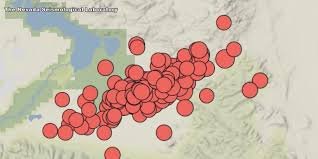
LYON COUNTY, Nev. – A magnitude 5.5 earthquake rattled western Nevada Monday evening, focusing attention on one of the state’s most active seismic zones. The tremor, centered approximately 12 miles from Silver Springs, has prompted discussions about earthquake preparedness and the potential for future events.
Nevada’s Seismic Landscape
Kyren Bogolub, a network seismologist with the University of Nevada, Reno (UNR) Laboratory, described the earthquake as one of the largest to hit Nevada in recent decades. “I’d estimate it’s among the seventh largest earthquakes in Nevada in the last 60 years,” Bogolub stated. This event is linked to the Walker Lane, a 600-mile-long system of faults running along the Nevada-California border.
“The Walker Lane is arguably the most seismically active part of Nevada,” Bogolub explained. “While it doesn’t always produce the largest earthquakes, it experiences the highest frequency of seismic activity.” She further indicated that a larger earthquake in the region isn’t unexpected, suggesting a magnitude 7 event is “not shocking” to anticipate.
Preparedness in Focus: UNR Medical Students Train for Disaster Response
Coincidentally, just a day after the earthquake, approximately 180 medical students at UNR participated in a comprehensive training exercise simulating a response to a major seismic event. The scenario included managing a surge of patients exceeding available medical resources.
Jennifer Delaney, UNR’s training and exercise coordinator, emphasized Nevada’s vulnerability. “Nevada is the third most seismically active state in the Union, following California and Alaska, making a large-scale disaster scenario entirely plausible.” The drill aimed to provide students with practical experience applicable to their future careers.
The timing of the exercise, so close to the actual earthquake, resonated deeply with the students. “It was… very interesting timing… to have an earthquake like that happen just one day before we had a training,” said Ozzie Tavares, a UNR medical student. “I think it made us all take it a lot more seriously… Nevada is always at risk for something like this to happen.”
Understanding the Walker Lane Fault System
The Walker Lane is a complex zone of geological deformation. It’s a right-lateral strike-slip fault system, similar to the San Andreas Fault in California, but more distributed. You can learn more about fault systems and earthquake science at the U.S. Geological Survey (USGS).
This recent earthquake serves as a stark reminder of the importance of earthquake preparedness for residents of Nevada and surrounding areas. Staying informed and having a plan can significantly improve safety during and after a seismic event.
Copyright 2026 KOLO. All rights reserved.



