
The Ultimate Celestial Quest: Hunting the Total Solar Eclipse
Imagine standing in a landscape where day suddenly turns to night, the temperature drops, and the sun’s shimmering corona emerges like a ghostly halo around the moon. This is the allure of the total solar eclipse, a celestial event so profound that it drives “eclipse chasers” to the farthest corners of the globe.
One such adventurer is Michael Zeiler, a veteran eclipse cartographer and founder of EclipseAtlas.com. Zeiler is currently aboard the Ocean Explorer, navigating toward the stunning fjords of Greenland. His mission? To witness the upcoming total solar eclipse and attempt a rare scientific feat: observing an aurora during the moment of totality.
Understanding the Path of Totality: Umbra vs. Penumbra
Not all eclipse experiences are created equal. The difference lies in where you stand in relation to the moon’s shadow. To understand this, we have to look at the physics of the shadow:
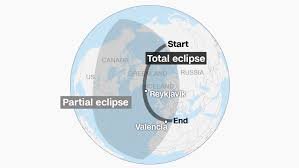
- The Umbra: This is the darkest, central part of the moon’s shadow. If you are within this narrow strip—known as the path of totality—the sun is completely blocked, and you experience the full magic of the eclipse.
- The Penumbra: This is the lighter, outer shadow. Those located here witness a partial solar eclipse, where only a portion of the sun is obscured.
During the current event, the path of totality spans a massive 8,300 kilometres, stretching from the Arctic coastline across Greenland, Iceland, northern Spain, and northeastern Portugal. While those in the path see the sun vanish, viewers in parts of North America, Europe, and Africa will only see a partial glimpse of the event.
The Precision of Prediction: How We Map the Stars
How can scientists predict exactly where a shadow will fall decades in advance? It is a blend of ancient wisdom and cutting-edge technology. According to experts from NASA and the European Space Agency (ESA), the process involves several complex factors:
1. The Saros Cycle
First recorded by the ancient Babylonians, the Saros cycle is a period of approximately 18 years that allows astronomers to identify repeating patterns of eclipses. While the path doesn’t repeat exactly due to Earth’s rotation, the cycle provides a foundational blueprint.
2. Delta T and Earth’s Rotation
Predicting an eclipse isn’t just about the moon and sun; it’s about the Earth’s unpredictable spin. Astronomers use a correction called Delta T to account for the slight differences between Earth’s predicted and actual rotation over time. This is why high-confidence predictions are typically limited to a window of 3,000 years into the future.
3. Modern Computational Models
Today, solar physicists use precise measurements of the Earth-Moon-Sun system to narrow the path of totality down to a precision of about one to one and a half kilometres.
Baily’s Beads and the Corona: What to Look For
For the seasoned chaser, the main event is only part of the draw. Many seek out Baily’s Beads—shimmering flashes of sunlight that peek through the rugged valleys and craters on the moon’s edge just before totality begins.
Once totality hits, the solar corona becomes visible. This outer atmosphere of the sun is usually hidden by the sun’s intense brightness but reveals itself as a stunning light show during the few minutes of darkness.
When is the Next Total Solar Eclipse?
If you missed the current window, don’t despair, but start planning your travels. Total solar eclipses are rare for any single location. Here are the upcoming dates to watch:
- August 2, 2027: Visible across North Africa and the Middle East.
- August 23, 2044: The next major total solar eclipse visible from parts of the contiguous United States.
Whether you are an “astronomy geek” or someone simply captivated by the beauty of nature, the total solar eclipse serves as a powerful reminder of our place in the vast, clockwork precision of the universe. As Michael Zeiler puts it, it’s an experience that brings an amazing light show to everyone, regardless of their scientific background.



