
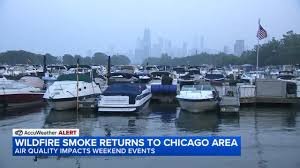
The Haze Returns: Understanding the Impact of Canada Wildfires on Chicago’s Air Quality
Residents of the Chicago area are once again facing a familiar, gray horizon. An Air Quality Alert remains in effect as smoke from devastating Canada wildfires continues to drift south, blanketing the city in a thick haze of pollutants. While the situation has shifted since the peak of the crisis, the air remains a concern for public health.
The Numbers: How Bad is the Air Quality?
According to AccuWeather meteorologists, Chicago has experienced a dramatic swing in its Air Quality Index (AQI). On Thursday, the city hit a staggering peak of 747—a level that is considered hazardous. By Sunday, the AQI had dropped to 156. While this is a significant improvement, it still falls within the “unhealthy” category, meaning the air can trigger health effects for the general population.
The good news? A change in wind direction is expected on Monday, which should help clear the smoke. However, the region remains under a “smoke watch” for the coming week, and a cold front may bring severe weather and strong storms by Monday evening.
Health Risks: More Than Just a Smell
Experts warn that wildfire smoke is not just a nuisance; it contains microscopic particles that can penetrate deep into the lungs and bloodstream. The American Lung Association emphasizes that if you can smell the smoke, you are breathing in harmful pollutants.
- n
- Respiratory Impact: Dr. Juanita Mora advises that the air is currently unhealthy for everyone, recommending that people stay indoors as much as possible.
- Eye Health: Dr. Soledad Cortina, a cornea specialist, notes that the components of wildfire smoke are similar to tobacco smoke, which can cause lasting damage to the eyes and aggravate chronic conditions.
- The Best Defense: Doctors recommend staying well-hydrated to help the respiratory system manage the irritation caused by smoky conditions.
Protecting Your Home and Health
The impact of poor Canada wildfires air quality isn’t limited to the outdoors. Airborne particles can easily seep into your living spaces and vehicles.
1. Optimize Your HVAC System
HVAC technicians suggest a critical check of your home air filters. As Karol Derezinski from Shavitz Heating and Air Conditioning explains, a filter might look clean, but if you cannot see light passing through it when held up to a lamp, it is clogged and needs immediate replacement to effectively scrub the air.
2. Smart Driving Habits
To reduce exposure while commuting, AAA recommends setting your vehicle’s air conditioning to recirculate mode. This prevents outside smoke and pollutants from entering the cabin, keeping the interior air cleaner.
The Big Picture: A New Climate Reality?
Is this the new normal? Patricia Ward, Head Scientist at the Griffin Museum of Science and Industry, suggests that these weather patterns are becoming more frequent across North America. She points toward climate change as a primary driver, contributing to more extreme weather events and more frequent, intense wildfire seasons.
For real-time updates on air quality in your specific zip code, you can visit AirNow.gov to stay informed and protect your health.



