
Beyond the Hexagon: The Mysterious Giant Decagon of Saturn’s South Pole
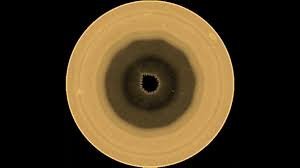
For decades, astronomers were fascinated by a singular, bizarre phenomenon: the massive hexagonal cloud pattern swirling around Saturn’s north pole. But as it turns out, the ringed planet had another secret hidden in the shadows. Recent findings have revealed a mysterious, giant 10-sided pattern of clouds—a decagon—forming around the Saturn south pole.
A Cosmic Surprise: The Decagon vs. The Hexagon
Since 1988, the scientific community has studied Saturn’s north pole hexagon, a structure roughly 20,000 miles (32,000 kilometers) wide. For years, it was believed to be a unique anomaly. However, the discovery at the Saturn south pole changes everything.
The newly discovered decagon is not just different in shape; it is significantly larger. Here is how they compare:
- n
- The North Pole Hexagon: Approximately 20,000 miles wide.
- The South Pole Decagon: A staggering 104,250 miles (167,820 kilometers) wide, with each of its ten sides measuring about 10,425 miles.
According to Agustin Sanchez-Lavega, a planetary scientist at the University of the Basque Country, this discovery proves that the hexagon is not a one-of-a-kind feature, opening new doors in our understanding of planetary meteorology.
How Hubble Unveiled the Mystery
You might wonder why it took so long to find this massive structure. The answer lies in the tilt of Saturn’s axis. From 2012 to 2023, the planet’s southern hemisphere was tilted away from Earth, making the Saturn south pole invisible to our telescopes.
It was only with recent images captured by the NASA Hubble Space Telescope in 2023 that the decagon finally came into view. The timing was perfect, revealing a phenomenon that had been hiding in plain sight for years.
The Science Behind the Shape: Atmospheric Waves
How does a planet create a perfect ten-sided polygon in its clouds? Researchers believe the decagon is the result of a meandering wave trapped by a curving atmospheric jet.
To test this theory, Sanchez-Lavega and his team used computer simulations of currents in shallow water. They found that small perturbations in the jet—similar to how air currents jostle one another—can cause the flow to meander into these geometric shapes. Unlike the stable north pole hexagon, the decagon varies in darkness, suggesting that it is still evolving.
What Lies Ahead for Saturn?
The scientific community is now racing to understand the long-term stability of this structure. One key date to watch is 2032, when solar radiation is expected to peak at the latitude of 60 degrees south. This increase in energy could either stabilize the decagon or cause it to break apart entirely.
By analyzing the three-dimensional structure of the clouds, hazes, and wind temperatures, scientists hope to develop more advanced models of planetary atmospheres, helping us understand not just Saturn, but other gas giants across the universe.
For more updates on the latest NASA missions and cosmic discoveries, stay tuned to our space exploration coverage.



