
Prepare Your Cameras: A Stunning Aurora Borealis Display May Be Coming!
There is nothing quite like the ethereal dance of the Aurora Borealis across the night sky. For nature lovers and photography enthusiasts across Canada, the latest data from the Space Weather Prediction Center (SWPC) suggests that we might be in for a treat this week.
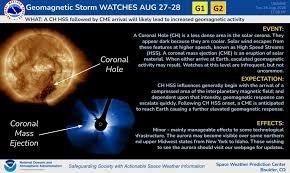
Solar activity is ramping up, and according to the National Oceanic and Atmospheric Administration (NOAA), a series of geomagnetic storms are expected to hit Earth’s atmosphere, potentially pushing the Northern Lights further south than usual.
What is Happening in Space?
To understand why we might see the Aurora Borealis, we have to look at the Sun. The current alerts are based on two distinct solar events:
- n
- August 27: A G1 (Minor) geomagnetic storm watch has been issued. This is primarily due to Coronal Hole High Speed Streams (CH HSS), which send a blast of solar wind toward Earth.
- August 28: The excitement increases with a G2 (Moderate) geomagnetic storm watch. This is caused by Coronal Mass Ejections (CMEs) that departed the Sun on August 25 and are now arriving in our neighborhood.
Will I Be Able to See the Northern Lights?
While a G1 storm usually keeps the lights confined to the far north, a G2 moderate storm increases the likelihood of the Aurora Borealis being visible in more southern Canadian regions. The intensity of the display depends on the orientation of the magnetic field within the solar wind.
If you are located in the Yukon, Northwest Territories, or Nunavut, your chances are excellent. However, those in Alberta, Saskatchewan, or Manitoba should keep a close eye on the horizon!
Tips for the Best Viewing Experience
If you want to catch a glimpse of this celestial phenomenon, follow these simple steps:
- Find a Dark Spot: Get as far away from city lights (light pollution) as possible.
- Check the Kp-Index: Use tools like NOAA’s Space Weather Prediction Center to monitor real-time geomagnetic activity.
- Look North: The Aurora typically starts as a faint glow on the northern horizon before moving overhead.
- Be Patient: Solar storms can fluctuate; the lights may appear and disappear in waves.
For more detailed astronomical forecasts, you can also visit SpaceWeather.com to stay updated on the latest CMEs and solar flares.
Don’t forget to charge your batteries and set your camera to a long exposure to capture the magic of the Aurora Borealis!



