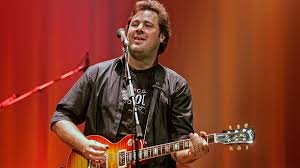
Vince Gill: A Versatile Guitar Legend and Country Icon
Vince Gill is a name synonymous with exceptional musicianship, heartfelt songwriting, and a remarkably versatile career. With over 30 million albums sold and a record-breaking 22 Grammy Awards – the most for any male country artist – Gill’s impact on music is undeniable. He’s also a decorated artist within the Country Music Association, boasting 18 awards, including two Entertainer of the Year honors and an unprecedented four Song of the Year wins. His recent recognition with the Willie Nelson Lifetime Achievement Award in 2025 further solidifies his legendary status.
From Early Beginnings to a Musical Prodigy
Gill’s connection to music began at a remarkably young age. “It has been part of me since before I had any memories at all,” he reflects. He even has a childhood photo of himself asleep on a couch, cradling a guitar. While his father played banjo and guitar, Gill’s passion wasn’t sparked by a single defining moment. It simply was.
Born in Norman, Oklahoma, Gill was encouraged by his father to explore various instruments – banjo, guitar, bass, mandolin, dobro, and fiddle – all while still in high school. His father provided his first guitars, including a unique four-string tenor model. “With my little hands, I could make chords on it a lot easier than I could on a six-string,” Gill explains. “I tuned it like the first four strings of a guitar.”
An Unaware Blues Singer
Gill’s first public performance came in second or third grade, and it’s a story he still laughs about. He recalls learning “The House of the Rising Sun” and singing it with complete innocence. “I sang a song about whorehouses in grade school and I didn’t even know it!” he exclaims. This anecdote perfectly illustrates his early, uninhibited approach to music, absorbing sounds and styles without fully understanding their context.
A Diverse Palette of Influences
Growing up, Gill was exposed to a wide range of musical genres, shaped by his family’s tastes. From the Beatles and the Stones to the sounds of the late 60s, his musical landscape was constantly evolving. He credits artists like Joe Walsh and Eric Clapton as early influences, learning songs like “Sunshine of Your Love” and immersing himself in the world of Led Zeppelin.
However, his influences weren’t limited to rock. Chet Atkins also played a significant role in his development. “In those days, I was playing more with a flatpick,” Gill says, “and not trying to figure out how Chet was doing what he did. I just loved the way he sounded.”
Bluegrass, California, and the Pursuit of Nuance
By his teens, Gill found himself drawn to bluegrass, which led him down a different musical path. A move to California in 1977 opened up new opportunities and exposed him to a wealth of talented musicians, including Larry Carlton, Robben Ford, and James Burton. He meticulously studied their techniques, particularly their string bending styles, and was profoundly inspired by Albert Lee, which ultimately led him to embrace the Telecaster guitar.
Gill’s ability to blend these diverse influences stems from his keen attention to detail and his appreciation for the subtleties that make each player unique. “I’m really interested in subtleties,” he explains. He doesn’t feel confined to a single genre, embracing the freedom to explore different styles. “If there’s a blues shuffle or something else where I get to scratch that itch, it’s enough,” he says. “I don’t feel I have to do a whole blues record just to prove I can. I like being a country guy, a blues guy, an R and B guy, a big ballroom singer or whatever.”
Source: GuitarPlayer