
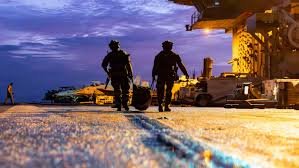
USS Gerald R. Ford: A Test of Endurance and Naval Power
In mid-March, a fire erupted aboard the USS Gerald R. Ford, the United States’ largest and most powerful aircraft carrier, while it was operating in the eastern Mediterranean Sea. The blaze, which broke out in the laundry department amidst ongoing operations related to tensions with Iran, took a dedicated crew 30 hours to extinguish, contain, and prevent from reigniting. Approximately 600 sailors were temporarily displaced from their bunks due to the damage, though thankfully, no serious injuries were reported.
A Deployment Unlike Any Other
This incident is just the latest in a series of challenges for the Ford’s crew, who are on track to break the record for the longest aircraft carrier deployment since the Vietnam War. The ship has been a central component of President Trump’s foreign policy, playing a key role in operations ranging from Venezuela to the escalating conflict with Iran. Despite a campaign platform criticizing US involvement in foreign conflicts, President Trump’s administration has seen a surge in military operations, with the Ford consistently at the forefront.
The Ford’s journey since departing Virginia in June has been a whirlwind. It navigated the Atlantic, initially heading to the Mediterranean and Norway for scheduled exercises, before being diverted to the Caribbean in response to the situation in Venezuela. A rapid redeployment to the Middle East followed, with a brief stop for toilet repairs along the way.
Operational Demands and Sailor Well-being
Just two days after the fire, the Ford resumed flight operations. A subsequent stop in Greece for repairs was followed by another in Croatia, ensuring the ship was available during a period of heightened tensions with Iran. This extended deployment is taking a toll on the sailors and their families.
“It’s constant uncertainty that we live on a daily basis,” shared Amini Osias, whose daughter serves on the Ford. “Sometimes, I can hardly sleep.” The downing of a US fighter jet by Iranian forces brought the dangers of the conflict into sharp focus for Osias, who expressed concern for his daughter’s safety.
Osias’ daughter, an aviation electrician, embodies the dedication of the Ford’s crew. While proud of her service, he questions the necessity of ongoing military intervention. “Is it really something we should fight and send our children to?” he pondered, emphasizing his primary duty as a parent: protecting his daughter.
Strain on Naval Assets and Future Implications
The challenges faced by the Ford, with its crew of 4,500 and numerous aircraft, raise broader questions about the sustainability of current operational tempos and their impact on the Navy’s ability to respond to future crises, particularly a potential conflict with China in the Pacific. While the toilet issues and laundry fire are specific to the Ford, long deployments inevitably lead to wear and tear on equipment, requiring constant maintenance and temporary fixes.
According to sources familiar with internal Navy discussions, the high operational tempo increases the risk of mishaps. The $13 billion Ford represents the pinnacle of US naval technology, but also highlights the limitations of maintaining such a complex and powerful asset.
“If we didn’t have the Ford, we would be struggling to maintain an operational presence, but we’d also be struggling to keep our aircraft carriers ahead of our enemies,” stated Brent Sadler, a 26-year Navy veteran and former submarine officer.
Addressing Morale and Retention
The Navy has been tight-lipped about the Ford’s specific role in recent operations, referring inquiries to US Central and Southern Command, which declined to provide details. However, Lt. Commander Ada Willis, a public affairs officer for Carrier Strike Group 12, assured that the Ford continues to operate effectively despite routine maintenance requirements.
Willis acknowledged that morale fluctuates during deployments but emphasized the resilience and dedication of the crew. To support the sailors, the Ford has a unique asset: Sage, a female Labrador retriever serving as a therapy dog. Sage, holding the rank of captain, is trained to reduce stress and encourage sailors to seek mental health support.
The Navy is also grappling with broader issues of sailor burnout and retention. Defense Secretary Pete Hegseth has ordered a review of attrition rates among Navy Strike Fighter Squadrons, and the Navy is offering substantial bonuses to retain experienced pilots and flight officers. “We’re at a point right now where retention’s not great,” said retired Vice Adm. Andrew “Woody” Lewis, citing deployment uncertainty and lengthy certification processes as contributing factors.
A Blessing and a Curse
Despite the challenges, former Navy officials believe the Ford’s crew embraces the demanding nature of their mission. “It’s a curse and a blessing at the same time, being on an aircraft carrier,” said Lewis, reflecting on his own 11 deployments. “You get extended, you get these long periods of you don’t know what the hell is going on.”